
The constitutional future of the United Kingdom has entered a new and potentially consequential phase after the leaders of Scotland, Wales and Northern Ireland signed a joint declaration calling for the British Government to prepare for, plan and facilitate constitutional change.
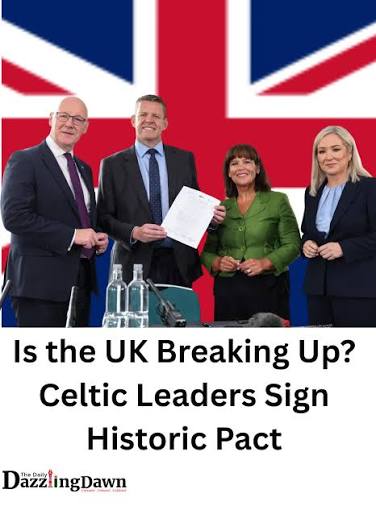
The memorandum of understanding was signed in Cardiff on September 14 by Scottish First Minister John Swinney, Welsh First Minister Rhun ap Iorwerth and Northern Ireland First Minister Michelle O’Neill, alongside Sinn Féin president and Irish opposition leader Mary Lou McDonald.
The meeting was conducted in their capacities as political party leaders rather than collectively as representatives of their governments.
The agreement marks the first time since devolution that Scotland, Wales and Northern Ireland have simultaneously been led by politicians whose parties support independence or Irish reunification.
The leaders declared that the political landscape across the islands was changing and argued that people in the three nations should have the right to determine their constitutional futures.
For Scotland, the declaration comes as the independence question moves back toward the centre of political debate. Swinney’s government published a draft Independence Referendum Bill in August, proposing the question: “Should Scotland be an independent country?”
The Scottish Government says the referendum would require the necessary constitutional powers to be transferred to Holyrood.
Scotland already held an independence referendum in 2014, when voters rejected independence.
The present political dispute therefore centres partly on whether circumstances have changed sufficiently to justify another vote and whether Westminster should approve the necessary legal mechanism.
The UK Parliament’s House of Commons Library notes that the legal authority to conduct a binding independence referendum remains a major constitutional issue.
Wales presents a different situation. Plaid Cymru, led by ap Iorwerth, supports Welsh independence, but the constitutional debate has developed more recently than Scotland’s and there is no equivalent established referendum process.
The Cardiff declaration nevertheless places Welsh self-determination alongside the Scottish and Irish questions in a broader debate about the structure of the UK.
Northern Ireland has a distinct constitutional route because the 1998 Good Friday Agreement provides for a border poll on Irish unity when the British Secretary of State considers that a majority is likely to support a united Ireland.
This makes Northern Ireland’s constitutional question legally different from those facing Scotland and Wales.
The declaration also comes amid renewed international attention. U.S. President Donald Trump recently expressed support for Irish reunification, although Downing Street has reiterated that Britain’s position on Irish unity has not changed and that any border poll would depend on the circumstances set out under the existing constitutional framework.
For Westminster, the development creates a complicated political challenge. Prime Minister Andy Burnham has rejected calls for an immediate Scottish independence referendum and has maintained that the Government’s position on Northern Ireland remains governed by the existing constitutional arrangements.
The significance of the Cardiff declaration therefore extends beyond the possibility of individual referendums.
It raises questions about whether the UK’s future will remain a highly centralized union, evolve toward a looser federal arrangement, or eventually consist of separate sovereign states cooperating with one another.
The declaration does not itself dissolve the United Kingdom, nor does it automatically trigger any referendum.
But it demonstrates an unprecedented level of coordination among nationalist parties governing three of the UK’s four constituent nations.
The coming years are likely to be defined by negotiations over democratic mandates, constitutional authority, economic arrangements, borders, trade, public finances and relations with the European Union.
For the United Kingdom, the debate has consequently shifted from whether demands for constitutional change exist to how Westminster and the devolved nations will respond to them.
The ultimate outcome, however, will depend on future elections, legislation, negotiations and where legally authorized decisions by voters themselves.