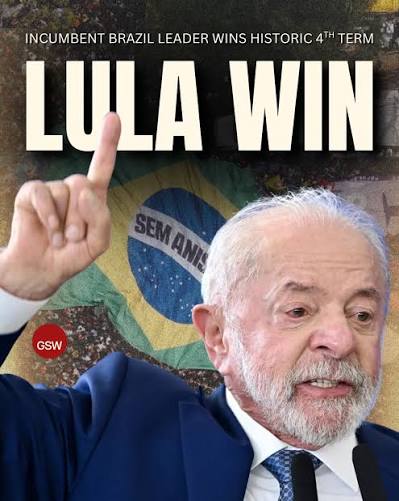
Brazilian President Luiz Inácio Lula da Silva has won re-election after defeating conservative Senator Flávio Bolsonaro in a closely contested presidential run-off, overturning his first-round defeat to secure another four-year term.
According to Brazil’s Superior Electoral Court (TSE), Lula of the Workers’ Party (PT) secured 51.79 per cent of valid votes, representing 64,256,232 ballots, against Bolsonaro’s 48.21 per cent, or 59,826,041 votes.
The result, announced on Sunday, October 25, gives the 80-year-old president a fourth non-consecutive term, an unprecedented achievement in Brazil’s modern presidential electoral history.
Lula’s victory followed a challenging first round on October 4, when Bolsonaro finished ahead with 47.03 per cent of the vote, compared with the incumbent’s 45.16 per cent.
The outcome represents a remarkable reversal, as Lula became the first Brazilian presidential candidate in the current democratic era to finish second in the first round and subsequently win the presidency in the run-off.
One of the major factors behind his comeback was an intensified campaign that combined digital mobilisation, public rallies and renewed engagement with voters.
Lula adopted a more informal approach on social media, using selfie-style videos to communicate directly with supporters.
The involvement of lawmaker André Janones also strengthened the campaign’s online mobilisation through a WhatsApp group known as the “Exército de Lula”, which reportedly attracted more than 10 million participants.
The campaign’s digital strategy complemented street demonstrations organised by students, social movements and supporters across several Brazilian cities.
Lula also sought to consolidate his traditional working-class support base by promising continuity and expansion of social programmes, alongside measures aimed at improving wages, education, healthcare and economic opportunities.
His long-standing association with poverty reduction and welfare initiatives, including Bolsa Família, remained central to his political appeal.
Turnout also played a significant role in the election. More than 128 million voters participated in the run-off, while abstention fell to approximately 19.21 per cent from 21.08 per cent in the first round.
However, the election exposed Brazil’s continuing political divisions, with Bolsonaro retaining substantial support among conservative voters.
The final hours of voting were also marked by controversy following a judicial decision extending voting until 7 p.m. in locations where polling remained open. Bolsonaro subsequently challenged the circumstances surrounding the extension and called for the result to be annulled.
Despite the dispute, electoral authorities confirmed Lula’s victory.
The president’s new mandate is expected to focus on economic growth, social protection, employment, environmental policy and Brazil’s international relations.
However, governing a politically divided country and addressing concerns over living costs, public finances and security will remain major challenges.
Lula’s victory reinforces his position as one of Latin America’s most prominent political figures while setting the stage for another closely watched chapter in Brazil’s political history.