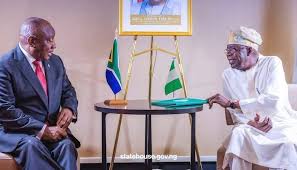
President Bola Ahmed Tinubu is expected to receive a special envoy from South African President Cyril Ramaphosa in Abuja after a direct telephone conversation between the two leaders helped ease a diplomatic standoff over renewed xenophobic attacks targeting Nigerians in South Africa.
The planned meeting represents a significant shift in Nigeria’s position after President Tinubu had initially declined to receive the South African delegation, citing concerns over the continued attacks on Nigerians, their businesses and properties.
The South African delegation, led by Minister of International Relations and Cooperation Ronald Lamola, arrived in Abuja on Friday, July 24, carrying a message from President Ramaphosa.
According to diplomatic sources in Abuja ,Nigeria’s seat of power, the delegation had been waiting in Abuja while efforts were made to resolve the impasse.
The situation reportedly changed following back-channel diplomatic efforts and a telephone call initiated by Ramaphosa over the weekend. Following the intervention, Tinubu agreed to meet the delegation later on Monday.
The meeting is expected to include officials from both countries, with Nigeria’s Minister of State for Foreign Affairs, Ambassador Sola Enikanolaiye, playing a key role. Foreign Affairs Minister Bianca Odumegwu-Ojukwu is currently in Addis Ababa and had earlier advised against Tinubu receiving the South African envoy while attacks against Nigerians continued.
The diplomatic tension comes against the backdrop of a growing crisis involving Nigerians and other African migrants in South Africa. Nigeria has repeatedly demanded stronger protection for its citizens and has condemned xenophobic violence as unacceptable.
Tinubu recently called on African countries to unite against what he described as “Afro-phobic attacks” in South Africa. Speaking through Vice President Kashim Shettima at the 69th Ordinary Session of the ECOWAS Authority of Heads of State and Government in Freetown, Sierra Leone, the President urged regional leaders to condemn the violence and raise the matter at the African Union level.
Tinubu also stressed that South Africa should remember the role played by other African nations, including Nigeria, in the country’s liberation struggle.
He argued that the sacrifices made by African countries should serve as a reminder of the need for solidarity rather than hostility towards fellow Africans.
Nigeria has already taken concrete measures to protect citizens affected by the crisis.
The Federal Government said it had evacuated 1,490 Nigerians from South Africa through a series of voluntary repatriation flights as of July 15.
The evacuations were conducted in response to security concerns arising from xenophobic attacks targeting foreign nationals.
The government has maintained that while Nigeria values its longstanding relationship with South Africa, the protection of Nigerians abroad remains a priority.
The forthcoming Tinubu-Ramaphosa diplomatic engagement could therefore provide an opportunity for both countries to address the immediate security concerns while working towards preventing further attacks.
For Nigeria, the central demand remains clear: Nigerians living and doing business in South Africa must be protected, while perpetrators of xenophobic violence must face appropriate consequences.
The meeting could also help prevent the current dispute from damaging broader Nigeria-South Africa relations, which remain important to political, economic and diplomatic cooperation across Africa.