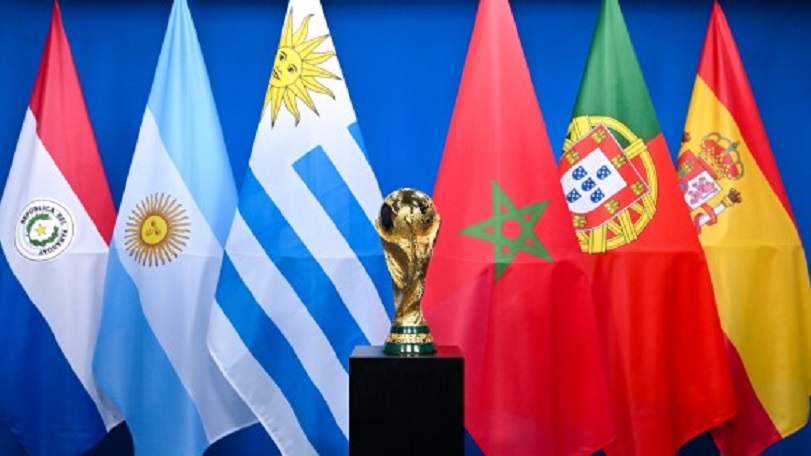
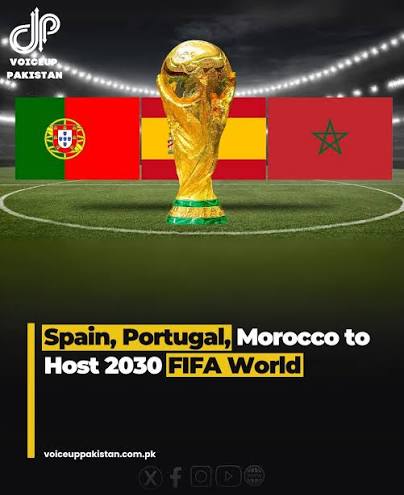
The FIFA World Cup will enter a new era in 2030 when Spain, Portugal and Morocco jointly stage the tournament, making it only the second consecutive World Cup to have multiple principal hosts following the 2026 edition in the United States, Canada and Mexico.
In addition, Uruguay, Argentina and Paraguay will each host one opening match as part of special centenary celebrations marking 100 years since the inaugural World Cup in Uruguay in 1930.
The unprecedented six-country arrangement reflects FIFA’s growing preference for shared hosting, a strategy the governing body believes is better suited to the expanding size and financial demands of modern World Cups.
The main tournament will be staged across Spain, Portugal and Morocco, with the vast majority of matches played in those three countries.
The three South American nations will each host a single opening fixture before the competition shifts entirely to Europe and Africa.
All six host nations will qualify automatically for the tournament.
FIFA President Gianni Infantino has repeatedly argued that co-hosting provides greater flexibility while allowing countries to share the enormous cost of staging football’s biggest event.
As the tournament continues to grow in size, building dozens of new stadiums and transport networks has become increasingly difficult for many nations to finance alone.
The expanded tournament, which debuted with 48 teams in 2026, requires more stadiums, more training facilities, additional accommodation and improved transportation infrastructure than any previous edition.
Those demands have made partnerships between neighboring countries increasingly attractive.
Spain brings world-class football stadiums such as Santiago Bernabéu, Camp Nou and San Mamés.
Portugal contributes established venues in Lisbon and Porto, while Morocco has invested heavily in modern stadiums and transport infrastructure after years of bidding to host the World Cup independently.
Together, the three nations offer FIFA a ready-made network of elite venues capable of handling the competition with fewer new construction projects.
Beyond infrastructure, FIFA also points to financial efficiency.
Hosting costs can now exceed several billion dollars, making it difficult for a single country to shoulder the burden.
Shared hosting allows governments to divide expenses while benefiting from tourism, global exposure and investment in transport and sporting facilities.
Environmental considerations have also become part of FIFA’s reasoning. Rather than constructing numerous new stadiums that may become underused after the tournament, multiple countries can rely more heavily on existing venues.
Critics, however, argue that the 2030 tournament’s intercontinental structure beginning in South America before moving to Europe and Africa will increase long-distance air travel for teams, officials and supporters.
The inclusion of Uruguay, Argentina and Paraguay is primarily symbolic.
Uruguay hosted and won the very first FIFA World Cup in 1930, and FIFA wanted the centenary edition to honor the competition’s origins while still awarding the main hosting rights to the Spain-Portugal-Morocco partnership.
The arrangement allows the tournament to celebrate its history without dramatically complicating the overall schedule.
The success of the 2026 World Cup across the United States, Canada and Mexico has reinforced FIFA’s confidence in multi-country hosting.
Officials believe shared tournaments can deliver larger fan experiences, greater commercial opportunities and improved regional cooperation while reducing the pressure placed on any single host nation.
Looking beyond 2030, FIFA appears unlikely to abandon the co-hosting model anytime soon.
As World Cups continue to expand in scale and commercial value, the governing body sees regional partnerships as the most practical way to stage future tournaments while maintaining high organizational standards.
For football fans, the 2030 World Cup promises a historic spectacle unlike any before it a tournament stretching across three continents, celebrating a century of World Cup history, and showcasing how international cooperation is becoming the new blueprint for the world’s biggest sporting event.