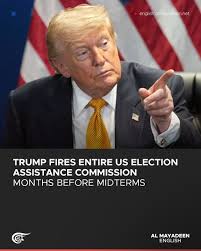
U.S. President Donald Trump has removed the remaining members of the bipartisan Election Assistance Commission (EAC), a federal agency responsible for supporting state and local election officials, in a move that has intensified political tensions just months before the country’s crucial midterm elections.
The dismissals, confirmed on Thursday by White House officials and people familiar with the matter, effectively leave the independent commission without leadership.
According to reports, the agency’s two Democratic commissioners were terminated, while the remaining Republican commissioner was permitted to resign, bringing the four-member panel to a standstill.
The Election Assistance Commission was established by Congress under the Help America Vote Act of 2002 following the disputed 2000 presidential election. Although it does not administer elections directly, the agency plays a key role in certifying voting systems, accrediting testing laboratories, distributing election administration grants, maintaining the national mail voter registration form, and providing guidance to election officials across the United States.
The sudden removal of its leadership comes at a particularly sensitive moment as election officials across the country prepare for the 2026 midterm elections, where control of Congress and numerous state offices will be contested.
According to reports, Democratic commissioners Thomas Hicks and Benjamin Hovland received emails informing them that their appointments had been terminated effective immediately. Republican Commissioner Christy McCormick was allowed to resign rather than being formally dismissed. The commission had already been operating with one vacant seat after former Commissioner Donald Palmer left earlier this year.
The White House defended the decision, saying the administration is committed to strengthening election security and ensuring that federal agencies align with the president’s policy priorities.
Officials also pointed to a recent U.S. Supreme Court ruling that expanded presidential authority to remove officials from independent federal agencies, a decision widely viewed as giving Trump greater control over executive branch appointments.
The dismissals are the latest in a series of actions by the Trump administration aimed at reshaping federal oversight of elections.
Since returning to office, Trump has repeatedly argued for stricter voting rules, enhanced voter identification requirements, and greater federal involvement in election administration.
The president has continued to question aspects of the 2020 presidential election, despite courts, election officials, and previous investigations finding no evidence of widespread fraud capable of changing the outcome.
His administration has also supported legislative efforts designed to tighten voting procedures nationwide.
Critics, however, warn that eliminating the commission’s leadership could disrupt election preparations and undermine confidence in the electoral process.
Senator Mark Warner described the dismissals as deeply concerning, arguing that an independent election agency should remain insulated from partisan influence, especially during an active election cycle.
Arizona Secretary of State Adrian Fontes also criticized the move, calling it “irresponsible and dangerous” because the commission provides vital technical assistance and voting system certification used by election officials nationwide.
Without commissioners, the EAC may be unable to take official actions requiring board approval, including adopting voting guidelines, certifying new voting equipment, or issuing formal policy decisions. Election experts say the operational uncertainty could complicate preparations for states relying on federal certification and guidance before November’s elections.
Supporters of the president argue that the dismissals fall squarely within executive authority and are part of broader efforts to improve election integrity and accountability within federal institutions.
Whether Trump will nominate new commissioners in time for Senate confirmation remains unclear. Any appointments would require Senate approval, leaving uncertainty about how quickly the commission could resume full operations. As campaigning intensifies across the United States, the unprecedented overhaul of the Election Assistance Commission is expected to fuel further political debate over election administration, presidential authority, and public confidence in America’s democratic institutions ahead of one of the country’s most closely watched midterm elections.