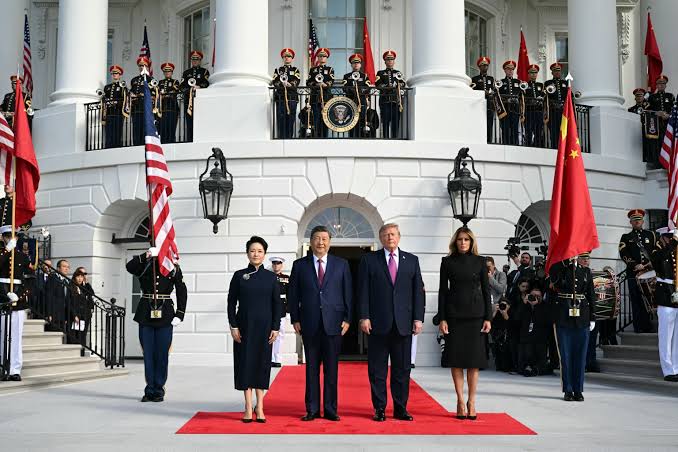
Some of the most powerful figures in American technology and finance gathered at the White House on Thursday night as President Donald Trump hosted Chinese President Xi Jinping and his wife, Peng Liyuan, for a lavish state dinner that placed corporate America at the centre of high-stakes US-China diplomacy.
The September 24 dinner brought together more than 130 guests, including an extraordinary concentration of technology executives, financial leaders and corporate chiefs.
The gathering was designed as a ceremonial celebration of Xi’s state visit, but the guest list also underscored the enormous economic stakes surrounding relations between Washington and Beijing.
Among the technology heavyweights attending were Nvidia chief executive Jensen Huang, OpenAI CEO Sam Altman, Tesla CEO Elon Musk, Meta CEO Mark Zuckerberg, Microsoft CEO Satya Nadella, Alphabet CEO Sundar Pichai, Apple executive chairman Tim Cook, Amazon founder Jeff Bezos and AMD chief executive Lisa Su.
The presence of so many technology leaders was particularly significant because artificial intelligence and advanced semiconductors have become central battlegrounds in the US-China relationship.
Both countries are racing to develop increasingly powerful AI systems while Washington continues to impose restrictions affecting China’s access to advanced computing technology.
Huang, Su, Cook and Musk were seated prominently near Trump and Xi, according to reports on the dinner.
The arrangement highlighted the importance of technology to the relationship between the world’s two largest economies.
Their companies collectively occupy crucial positions in semiconductors, consumer electronics, electric vehicles and artificial-intelligence infrastructure.
Wall Street was equally well represented.
Among the financial executives invited were Citigroup CEO Jane Fraser, JPMorgan Chase CEO Jamie Dimon, Blackstone chairman Stephen Schwarzman, Goldman Sachs CEO David Solomon and Mastercard CEO Michael Miebach.
Their participation reflected the importance of investment, financial services and cross-border business to the broader US-China economic relationship.
The dinner came against a complicated backdrop. Washington and Beijing remain strategic competitors over trade, technology, manufacturing, national security and global influence.
At the same time, American corporations maintain substantial commercial interests in China, making stability between the two countries important for businesses operating across global supply chains.
For technology companies, China represents both a major market and a critical part of the global manufacturing ecosystem.
Tesla, Apple and numerous other American corporations have extensive commercial or production links to the Chinese economy.
Nvidia, meanwhile, faces the particularly sensitive challenge of navigating US export controls while seeking to maintain access to one of the world’s largest technology markets.
Artificial intelligence was therefore an unavoidable theme surrounding the gathering.
The United States and China are competing intensely for leadership in AI, while policymakers and technology executives are simultaneously confronting questions about safety, regulation, employment and the potential consequences of increasingly powerful systems.
OpenAI has recently called for greater international cooperation on AI standards, including dialogue between Washington and Beijing over emerging risks.
The company’s position comes as governments and technology companies grapple with how to encourage innovation without allowing potentially dangerous applications of AI to develop unchecked.
Interestingly, the Chinese delegation was comparatively small and included few, if any, major business leaders.
Bloomberg reported that of more than 130 names on the American guest list, only 19 were part of the Chinese delegation, with no Chinese business figures represented.
Trump nevertheless portrayed the event as an extraordinary gathering of American corporate power, describing the guest list as encompassing the technology and banking worlds.
Beyond the formal speeches, dinner and ceremony, the gathering provided an unusual setting where political leadership, technological power and financial influence converged around one table.
The spectacle also demonstrated a central reality of the US-China relationship: even as Washington and Beijing compete for strategic and technological advantage, their economies remain deeply connected.
The presence of America’s leading technology and financial executives alongside Xi and Trump served as a vivid reminder that the future of global commerce may depend as much on managing those competing interests as on winning them.