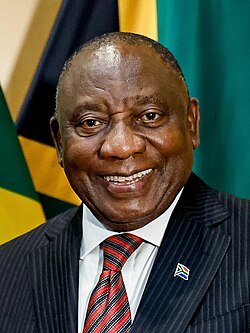
South African President Cyril Ramaphosa has secured a major legal victory after the Western Cape High Court overturned a controversial parliamentary report that threatened to expose him to possible impeachment over the 2020 theft of approximately $580,000 from his private Phala Phala game farm.
The unanimous judgment, delivered on Wednesday, November 25, 2026, declared the findings of an independent parliamentary panel unlawful and set aside the report in its entirety.
The ruling effectively removes the legal foundation for the impeachment proceedings that had been revived against the president following an earlier Constitutional Court decision.
According to Reuters, the court found that the independent panel fundamentally misunderstood its responsibilities, exceeded its lawful mandate and committed several significant errors in interpreting the law.
Presiding Judge President Nolwazi Mabindla-Boqwana, delivering the judgment on behalf of the three-member panel, said the investigation had applied the wrong legal standards in examining the allegations against Ramaphosa.
The court also declared unlawful the steps taken by South Africa’s National Assembly pursuant to the disputed report.
The judgment represents a significant reprieve for the 74-year-old president, who has consistently denied wrongdoing in connection with the controversy popularly known as the Phala Phala scandal or Farmgate.
How the Phala Phala Controversy Began
The controversy dates back to February 2020, when burglars reportedly broke into Ramaphosa’s Phala Phala game farm in Limpopo province and stole approximately $580,000 in foreign currency concealed inside furniture.
The incident became public in June 2022 after former South African intelligence chief Arthur Fraser reported the matter to the police.
Fraser alleged that Ramaphosa concealed the burglary from law enforcement authorities and tax officials and questioned the origin of the substantial amount of foreign currency found on the property.
He also raised concerns about the circumstances surrounding the investigation and the alleged involvement of presidential security personnel.
Ramaphosa, however, maintained that the stolen money represented legitimate proceeds from the sale of buffaloes on his farm.
He denied allegations of corruption, money laundering and abuse of presidential authority.
The Panel Report That Threatened His Presidency
Following the controversy, an independent parliamentary panel chaired by former Chief Justice Sandile Ngcobo investigated the allegations.
In November 2022, the panel concluded that there was prima facie evidence suggesting that Ramaphosa might have committed serious misconduct and potentially violated constitutional provisions.
The findings triggered a political storm and threatened his position as leader of the ruling African National Congress (ANC).
Although Parliament initially rejected moves to advance impeachment proceedings, the Constitutional Court ruled in May 2026 that lawmakers had acted unconstitutionally in blocking the process.
The decision paved the way for the establishment of an impeachment committee to examine the allegations.
Ramaphosa subsequently returned to court, challenging the validity of the original panel report and arguing that its findings were legally defective.
Court Identifies Errors in Investigation
In its latest judgment, the Western Cape High Court found that the independent panel had misunderstood the nature of its assignment and relied on an incorrect interpretation of the evidence required to justify further proceedings.
The judges also questioned aspects of the panel’s treatment of allegations concerning Ramaphosa’s farming business, the reporting of the burglary and the activities of presidential security officials.
The court stressed that a process with such serious constitutional and political consequences must be founded on a lawful and properly conducted investigation.
Political Implications for Ramaphosa
The ruling provides considerable political relief for Ramaphosa, whose presidency has faced mounting challenges amid economic difficulties, political divisions and declining electoral fortunes for the ANC.
Although the judgment could still face an appeal, it significantly weakens the immediate prospect of parliamentary impeachment proceedings arising from the Phala Phala report.
Ramaphosa is expected to remain president until the end of his current constitutional term in 2029, barring any major political developments.
For now, Wednesday’s judgment represents one of his most consequential legal victories since the scandal emerged, bringing fresh uncertainty to opposition parties seeking accountability over the controversial farm burglary.