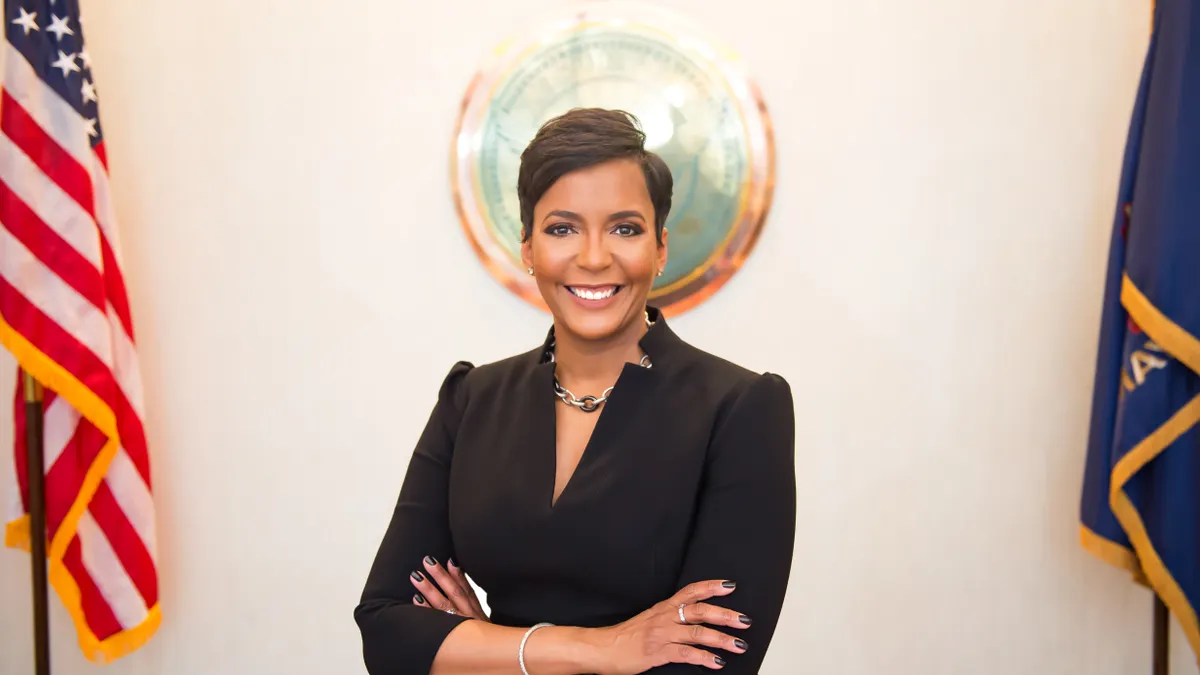
Keisha Lance Bottoms has made American political history after emerging victorious in Georgia’s gubernatorial election, becoming the first Black woman ever elected governor of a state in the United States.
The Democratic candidate defeated Republican businessman Rick Jackson in Tuesday’s November 3, 2026, midterm elections, delivering a landmark victory that breaks a longstanding racial and gender barrier in American politics.
Her victory is particularly significant for Georgia, which has never previously elected a woman or a Black person to its highest political office.
She will also become the state’s first female governor, succeeding outgoing Republican Governor Brian Kemp.
According to media projections, Bottoms secured the historic victory despite facing a formidable financial challenge from Jackson, a billionaire healthcare executive who reportedly invested more than $200 million of his personal fortune in his campaign.

The outcome also represents a major political shift in Georgia, where Republicans have dominated the governor’s office for more than two decades.
Bottoms, 56, is no stranger to public service. She previously served as mayor of Atlanta from 2018 to 2022, earning national recognition for her leadership during the COVID-19 pandemic and the protests that followed the killing of George Floyd in 2020.
Before entering politics, she built a career in law, serving as an attorney and magistrate judge in Fulton County. She subsequently became a member of Atlanta’s City Council in 2009 before rising to the city’s highest political office.
Following her tenure as mayor, Bottoms joined the administration of former President Joe Biden, serving as director of the White House Office of Public Engagement and later as a senior adviser.
Her gubernatorial campaign focused on issues affecting ordinary Georgians, including the rising cost of living, healthcare affordability, housing, employment opportunities and voting rights.
Among her major policy commitments was expanding Medicaid coverage under the Affordable Care Act, alongside efforts to address healthcare inequalities and protect reproductive rights.
Her campaign also received significant political support from prominent Democratic figures, including former President Barack Obama and Senator Jon Ossoff, who campaigned alongside her in the closing stages of the election.
Jackson, meanwhile, presented himself as a political outsider, campaigning on tax cuts, public safety and deregulation. His defeat represents a setback for Republicans and President Donald Trump, who had endorsed his candidacy.
In her victory remarks, Bottoms expressed gratitude to Georgia voters and pledged to govern beyond party and racial divisions.
She also reflected on the historical significance of her achievement, recalling her great-great-grandmother, Betsy Peek, who was born before the abolition of slavery in the United States.
The governor-elect’s triumph carries considerable symbolic importance for Black women, who have historically faced significant barriers to attaining the highest levels of political leadership.
Her election also follows years of growing political participation by Black women across the United States, particularly in Southern states.
Bottoms is expected to assume office in January 2027, when she will begin a new chapter in Georgia’s political history.
Her victory is more than a personal electoral achievement; it represents a historic moment in America’s continuing journey towards broader political representation.