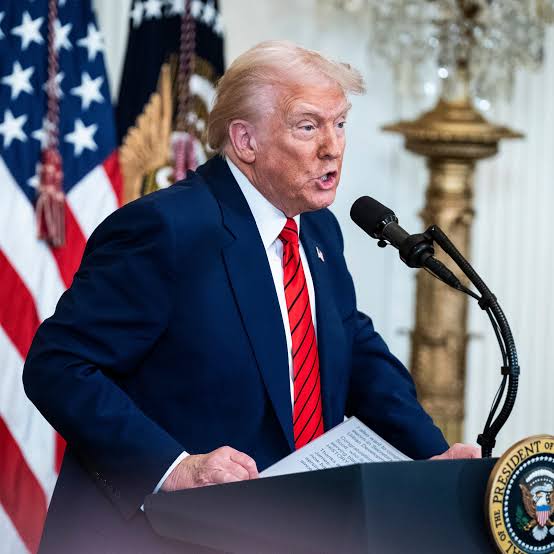
U.S. President Donald Trump has reignited debate over presidential term limits after claiming he has the right to seek a third term in office, despite constitutional provisions limiting presidents to two elected terms.
The remarks have renewed questions about the future of American democracy and whether the president could attempt to remain in power beyond the traditional two-term limit.
Under the 22nd Amendment to the United States Constitution, ratified in 1951, no person can be elected president more than twice. The amendment was adopted following Franklin D. Roosevelt’s unprecedented election to four presidential terms.
Trump, who returned to the White House in January 2025 after winning the 2024 presidential election, is serving his second, non-consecutive term. He previously served from 2017 to 2021.
His latest comments have attracted attention because, under the existing constitutional framework, he would ordinarily be ineligible to contest another presidential election in 2028.
Iowa rally revives third-term controversy
Speaking at a rally in Sioux City, Iowa, on Thursday, October 22, Trump again raised the possibility of contesting the 2028 presidential election.
He questioned whether the law prevented him from running again before repeating his longstanding allegation that Democrats had stolen the 2020 election from him. The claim of widespread election fraud in 2020 has not been substantiated.
Trump’s argument appears to rest partly on his insistence that he should have won the 2020 election, which he lost to former President Joe Biden. However, the official constitutional term limit is based on elections and the terms served, not on a candidate’s disputed claims about an earlier election.
The 22nd Amendment states that no person shall be elected president more than twice. Trump won the presidency in 2016 and 2024, meaning he has been elected twice.
Constitutional experts have pointed out that changing the restriction would require a constitutional amendment, a demanding process that generally needs approval by two-thirds of both chambers of Congress and ratification by three-fourths of the states.
Trump has previously floated possible ways around the restriction, including scenarios involving Vice President JD Vance, but such proposals raise significant constitutional questions and have not established a lawful route to a third elected term.
Political implications
The renewed remarks come as American political parties prepare for the 2026 midterm elections, which will determine control of Congress and influence the remainder of Trump’s presidency.
For Trump’s supporters, his comments may reflect a desire to maintain political influence and continue his policy agenda beyond 2028. Critics, however, view repeated suggestions of a third term as a challenge to the constitutional safeguards governing the peaceful transfer of power.
Despite his claims, Trump cannot lawfully be elected to a third presidential term under the Constitution as it currently stands. Any attempt to alter that position would face substantial legal, political and institutional obstacles.
For now, his latest comments have renewed debate over presidential power, electoral legitimacy and the strength of America’s democratic institutions.