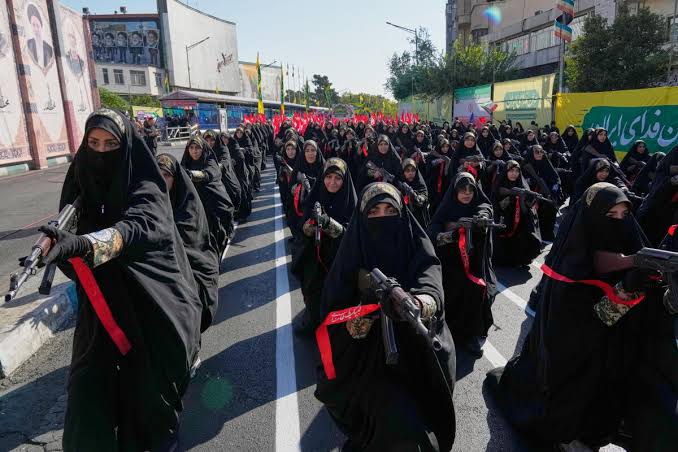
Hundreds of thousands of Iranians took to the streets of Tehran on Friday in the largest government-organised demonstration since the war between Iran, the United States and Israel began in February, with participants pledging to defend their country and volunteer for limited military training.
The rally, described by Iranian authorities as “Janfaday-e Iran”, meaning “those who sacrifice their lives for Iran,” was designed to project national unity and defiance after months of fighting, sanctions and growing economic pressure.
Participants marched through central Tehran carrying Iranian flags, while some wore military-style uniforms.
The event also featured displays of weapons and military equipment, including drones and anti-aircraft systems associated with Iran’s Revolutionary Guard.
Iranian officials gave varying figures for participation. Revolutionary Guard chief Gen. Hassan Hassanzadeh said more than 600,000 people had registered for the military-training programme, while Iranian state television estimated that more than 300,000 people were on Tehran’s streets during Friday’s demonstration. Officials said more than one million people could eventually participate in the training.
The programme is intended to create an additional pool of people capable of defending the country alongside Iran’s powerful Islamic Revolutionary Guard Corps and its volunteer Basij organisation.
Hossein Taeb, the newly appointed head of the Basij, told the crowd that the volunteers would be prepared for what he described as “full-fledged defense.” He also indicated that similar rallies would be held in other Iranian cities.
The demonstrations came as Iran faces severe economic challenges linked to the continuing conflict, U.S. sanctions and a naval blockade affecting Iranian ports. The pressure has compounded existing economic difficulties and contributed to growing concerns about shortages, inflation and the cost of basic goods.
The rally also carried a strong anti-American and anti-Israeli message. Some demonstrators chanted slogans against the United States and Israel, while others trampled on their flags. Posters and caricatures targeting U.S. President Donald Trump were also visible among the crowds.
For the Iranian government, the mobilisation offers an opportunity to demonstrate that support for the country remains substantial despite the prolonged conflict and economic hardship. It also allows
Tehran to emphasise resistance and national solidarity at a time when its military and political leadership remain under intense external pressure.
However, the size of the government-organised gathering does not necessarily provide a complete picture of public opinion across Iran.
The country has experienced significant anti-government protests in recent months, including demonstrations driven initially by economic grievances before expanding into broader political opposition.
The Associated Press reported that activists have accused authorities of using extensive force during those protests, while Iranian officials have disputed accounts of the unrest and attributed it to foreign-backed groups.
The mobilisation therefore carries a dual significance. Internationally, it sends a message to Washington and its allies that Tehran intends to maintain resistance despite military and economic pressure.
Domestically, it demonstrates the government’s ability to mobilise large crowds and strengthen its security structures during wartime.
The rally also comes amid continuing tensions around the Strait of Hormuz, a critical global energy route where the conflict has disrupted shipping and contributed to uncertainty in international oil and gas markets.
Iran has displayed drones and other military equipment used in the region as part of its broader message of military readiness.
As the war continues, Friday’s demonstration represents one of the clearest public displays yet of Iran’s official strategy: combine patriotic mobilisation, military preparedness and political messaging to withstand external pressure while maintaining control at home.