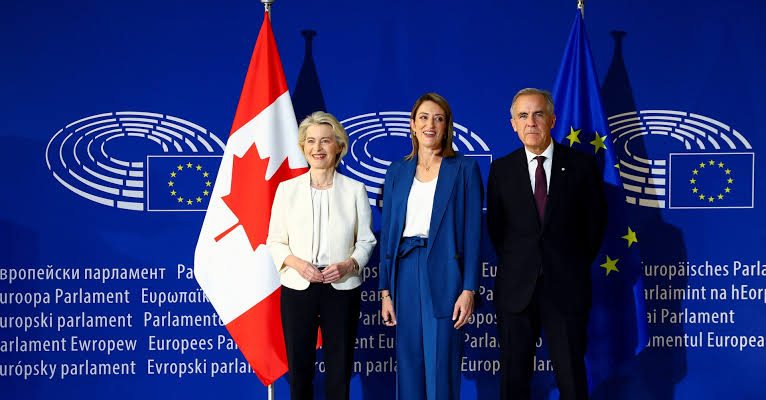
The European Union has opened the door to a potentially unprecedented relationship with Canada, with European Commission President Ursula von der Leyen proposing that Canada become the bloc’s first “associate member.”
Von der Leyen made the proposal on Wednesday, September 16, 2026, during her annual State of the Union address to the European Parliament in Strasbourg, where Canadian Prime Minister Mark Carney was present.
“I would like to work with you on opening the door for Canada being the first associate member of the EU,” von der Leyen told Carney, signaling an ambition to take relations between Canada and the 27-member bloc to a new level.
The proposal comes amid heightened geopolitical and economic tensions involving Canada and the United States.
Carney’s government has been pursuing greater diversification of Canada’s international trade and strategic partnerships as relations with Washington have become more difficult.
Von der Leyen described the proposed expanded relationship as an “Alliance for the Future”, designed to create a broader area of shared prosperity and economic security.
Areas of cooperation could include trade, artificial intelligence, climate policy, critical minerals, supply chains, defense and Arctic security.
Canada already has extensive institutional ties with the EU. The two sides have a Strategic Partnership Agreement and the Comprehensive Economic and Trade Agreement, known as CETA.
The European Parliament has also called for much deeper EU-Canada cooperation in areas including cybersecurity, defence technology, energy and climate change.
Canada has additionally become increasingly involved in European security initiatives.
In February 2026, Ottawa and the EU signed an agreement allowing Canadian participation in the EU’s SAFE defence instrument, making Canada the only non-European country participating in the programme.
However, the proposed “associate member” status does not yet have a defined legal framework within the EU treaties and has not been formally established.
EU diplomats have reportedly expressed uncertainty over what such a status would entail, while any major institutional change would require the agreement of EU member states.
The initiative is therefore at an early stage. Further discussions are expected at the Canada-EU summit scheduled for October in Montreal, where officials are expected to examine stronger cooperation in trade, technology, defence and Arctic affairs.
For Canada, the proposal could mark a significant expansion of its relationship with Europe, while for the EU it would represent a new model for cooperation with a close democratic partner outside the bloc.