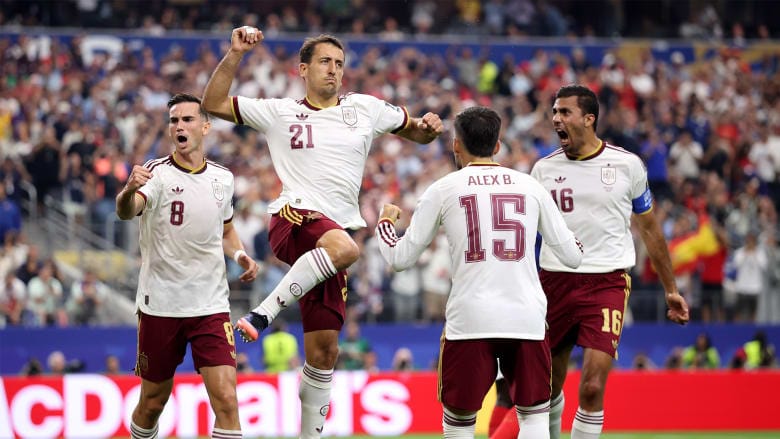
Spain booked their place in the 2026 FIFA World Cup final with a commanding 2-0 victory over France in a pulsating semifinal that highlighted the gulf in execution between two of Europe’s football heavyweights.
While France arrived in the last four boasting one of the tournament’s strongest defensive records and a squad packed with world-class talent, it was Spain’s tactical discipline, relentless pressing and clinical finishing that proved decisive.
For France, the defeat was a bitter end to a campaign that had promised so much. Didier Deschamps’ men had progressed steadily through the knockout rounds, defeating Paraguay in the Round of 16 before overcoming Morocco in the quarterfinals.
Their semifinal clash against Spain was expected to be a tactical chess match between two teams capable of dominating possession and punishing mistakes.
Instead, Spain dictated proceedings almost from the opening whistle.
The Spanish midfield, widely regarded as one of the tournament’s finest, controlled possession and prevented France from establishing any rhythm.
Every attempt by France to build attacks through midfield was met with aggressive pressing, forcing hurried passes and uncharacteristic errors.
Spain’s patience eventually paid off midway through the first half when a flowing team move sliced open the French defence.
After several quick exchanges around the penalty area, Spain found the breakthrough with a composed finish that left the French goalkeeper helpless.
Rather than responding immediately, France struggled to recover.
The opening goal appeared to unsettle Les Bleus, whose usually composed defenders began giving away possession in dangerous areas.
Spain sensed vulnerability and continued attacking with confidence, stretching France across the width of the pitch.
The second goal shortly after the interval effectively ended France’s hopes. A rapid counterattack exposed the space left behind by France’s advancing full-backs, and Spain clinically doubled their advantage with another well-worked finish.
Although France enjoyed more possession during the final half-hour, they rarely looked capable of breaking down Spain’s disciplined defensive structure.
Much of France’s disappointment centered on their attacking stars, who failed to impose themselves on the biggest stage.
The team’s forwards found themselves isolated for long periods, receiving little support from midfield as Spain compressed the central areas of the pitch. France’s creative players, so influential throughout the tournament, were repeatedly crowded out before they could turn and attack.
Whenever France attempted to build patiently from the back, Spain’s high press forced turnovers that immediately turned into dangerous counterattacks.
The inability to create clear-cut opportunities became France’s biggest weakness.
Despite enjoying spells of possession, Deschamps’ side produced few genuine chances inside Spain’s penalty area. Long-range efforts were comfortably handled, while crosses into the box were routinely cleared by Spain’s well-organized defense.
Several tactical decisions also came under scrutiny after the defeat.
France appeared reluctant to alter their approach despite struggling to break through Spain’s compact midfield.
Even after falling behind, they continued playing cautiously instead of increasing the tempo and committing additional numbers forward.
By the time attacking substitutions were introduced, Spain had already settled into a defensive rhythm that proved extremely difficult to disrupt.
Fatigue may also have played a role.
France had relied heavily on many of the same key players throughout the tournament, and signs of physical exhaustion became increasingly evident during the semifinal. Spain, meanwhile, rotated effectively during earlier rounds and looked fresher, quicker and sharper in nearly every duel.
The contrast was especially noticeable during transitions.
Whenever possession changed hands, Spain sprinted forward with purpose while France often appeared a step behind. Those extra seconds allowed Spain to exploit spaces before the French defence could reorganize.
Another major factor behind France’s defeat was Spain’s exceptional midfield control.
The Spanish trio consistently dictated the pace of the match, recycling possession intelligently while preventing France from launching quick counterattacks.
Their movement off the ball continually created passing options that frustrated the French press.
France’s midfielders spent much of the evening chasing shadows rather than influencing play.
Defensively, Spain were equally impressive.
Their centre-backs won crucial aerial battles, while the full-backs balanced defensive duties with attacking support. Every time France threatened to build momentum, Spain calmly regained possession and slowed the tempo before launching another attack.
For France, the semifinal exposed several issues that coaching staff will likely analyse in depth.
First, the team lacked creativity once opponents successfully neutralized their primary attacking outlets.
Second, France struggled against coordinated high pressing throughout the match, often surrendering possession in dangerous areas.
Third, the absence of quick tactical adjustments allowed Spain to maintain complete control during long stretches of the contest.
Despite the disappointment, France can still take positives from their overall World Cup campaign.
They reached another semifinal, demonstrated defensive resilience throughout most of the tournament and continued to showcase one of the deepest talent pools in international football.
However, against elite opponents capable of dominating possession, France’s limitations became evident.
Spain, meanwhile, looked every bit like potential world champions.
Their blend of youthful energy and experienced leadership has made them one of the tournament’s standout teams. From their convincing victories over Austria and Portugal to a hard-fought quarterfinal triumph against Belgium, Spain have steadily improved with each knockout match.
Their latest victory over France further reinforced their credentials.
Every department functioned efficiently from the composed defence to the tireless midfield and ruthless attack making Spain deserving finalists.
As attention now turns to the World Cup final, Spain will carry enormous confidence after eliminating one of football’s traditional powerhouses. France, meanwhile, must regroup quickly before the third-place playoff, reflecting on what went wrong and how a team filled with talent ultimately fell short when it mattered most.
The semifinal served as a reminder that success at the World Cup depends not only on individual brilliance but also on tactical discipline, collective teamwork and clinical finishing—qualities Spain displayed in abundance as they marched into the biggest match in world football.