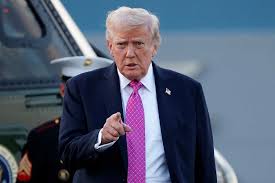
The directive, announced during the NATO summit in Ankara, Turkey, marks one of the most severe diplomatic confrontations between two long-standing allies in recent years.
Trump instructed U.S. Treasury Secretary Scott Bessent to stop trade with Spain “immediately,” describing the country as a “terrible partner” within the alliance and saying he no longer wanted the United States to conduct business with Madrid.
Reuters reported that the president’s comments came after weeks of renewed tensions over defence spending and Spain’s continued opposition to the U.S.-led military campaign involving Iran.
Speaking alongside NATO Secretary General Mark Rutte, Trump expressed frustration that Spain had failed to contribute what he considers a fair share to collective defence while simultaneously refusing to back U.S. military operations in the Middle East.
“I don’t want to do any trade with them,” Trump reportedly said before directing Treasury officials to implement the measure without delay.
He also accused Spain of benefiting economically from the United States while contributing too little to the alliance’s security efforts.
The announcement overshadowed a NATO summit that had been expected to focus on strengthening unity among member states amid heightened geopolitical tensions. Instead, Trump’s remarks exposed fresh cracks within the alliance, particularly over military spending and differing approaches to the conflict involving Iran.
Spain has consistently resisted pressure to significantly increase defence expenditure to the level sought by Washington.
Prime Minister Pedro Sánchez has argued that each NATO member should retain the flexibility to determine its own defence commitments based on national priorities rather than fixed percentage targets.
Madrid has also maintained its opposition to direct military involvement in the conflict with Iran.
Earlier this year, Spain declined U.S. requests to allow American forces to use the jointly operated military bases at Rota and Morón for offensive operations against Tehran, insisting that it would not support actions it believed could escalate the regional conflict.
That decision became a major source of friction between the two governments.
Despite Trump’s latest order, legal experts questioned whether the White House possesses the authority to completely halt trade with Spain.
Unlike bilateral trading partners, Spain is a member of the European Union, meaning trade policy is negotiated collectively by Brussels rather than by individual member states.
Analysts note that any attempt to impose a comprehensive trade embargo would likely require the declaration of a national emergency under U.S. law and could face significant legal and diplomatic challenges.
Spain’s government moved quickly to downplay the announcement, describing the latest threat as political rhetoric while reaffirming its commitment to maintaining strong economic and security ties with the United States.
Officials in Madrid stressed that Spain remains an important NATO member and that trade negotiations are conducted through the European Union rather than on a bilateral basis.
They also pointed to decades of military cooperation between the two countries, including the continued presence of American forces at Spanish naval and air bases.
Although diplomatic tensions have intensified, neither side has announced any changes to existing military cooperation arrangements.
The latest confrontation also comes at a sensitive moment for global markets.
Investors reacted cautiously as Trump’s comments coincided with renewed uncertainty surrounding the conflict with Iran. Financial markets registered declines after the U.S. president declared that the ceasefire with Iran was effectively over following recent Iranian attacks, raising concerns that hostilities in the Middle East could intensify further.
The combination of geopolitical uncertainty and the threat of new trade restrictions added to volatility across international financial markets.
Economists warn that an actual suspension of trade would have significant consequences for businesses on both sides of the Atlantic.
The United States exports billions of dollars’ worth of goods annually to Spain while importing a wide range of Spanish products, including machinery, pharmaceuticals, food products and wine. American investment in Spain also remains substantial despite recent declines.
Industry observers noted that sectors such as agriculture, tourism and manufacturing could be particularly vulnerable if trade barriers were implemented, while European Union officials would almost certainly challenge any unilateral U.S. action through diplomatic and legal channels.
The dispute reflects broader disagreements that have emerged between Washington and several European capitals over defence policy, burden-sharing within NATO and the appropriate response to escalating tensions in the Middle East.
For Trump, increasing defence contributions from NATO allies has remained a central foreign policy objective throughout his presidency.
Spain’s refusal to fully embrace Washington’s security priorities, particularly regarding Iran, has made it a frequent target of criticism from the White House.
Whether Trump’s latest order translates into enforceable policy remains uncertain. Legal challenges, European Union trade regulations and the strategic importance of the U.S.-Spain partnership could all complicate implementation.
Nevertheless, the announcement represents one of the strongest signals yet that disagreements over defence spending and the Iran conflict are spilling beyond military cooperation into economic relations, creating fresh uncertainty for NATO allies already navigating an increasingly volatile international security environment.