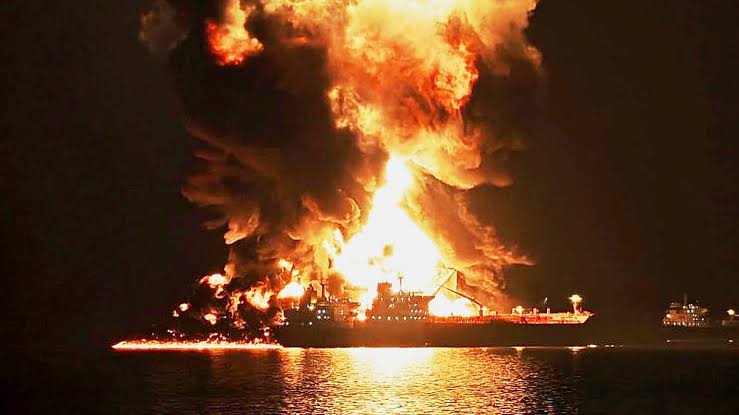
The fragile peace that followed the recent conflict between Iran, Israel and the United States faced fresh strain on Thursday after a cargo vessel was struck in the strategically important Strait of Hormuz, reigniting concerns about maritime security, global oil supplies and the future of negotiations over Iran’s nuclear programme.
According to a U.S. official, Iran’s Revolutionary Guards targeted a commercial cargo vessel sailing near the coast of Oman.
The attack damaged the ship’s bridge but caused no casualties. The United Kingdom Maritime Trade Operations (UKMTO), which monitors shipping activity in the region, confirmed that the vessel sustained damage but that all crew members were safe.
The latest incident underscores the continuing volatility in the Strait of Hormuz, a narrow waterway through which roughly one-fifth of the world’s oil supply passes daily.
Any disruption in the channel has the potential to send shockwaves through global energy markets and international trade.
The vessel strike came amid growing debate over how maritime traffic in the Strait should be managed following recent hostilities in the Gulf. Iran has floated proposals for a new administrative framework for shipping movements through the waterway, sparking concerns among Western governments and shipping companies that Tehran could attempt to impose transit fees or exert greater control over one of the world’s most critical maritime chokepoints.
U.S. Secretary of State Marco Rubio firmly rejected suggestions that Iran could charge vessels for passage through the Strait. Speaking to reporters, Rubio reiterated Washington’s position that freedom of navigation must be maintained and that no nation should be allowed to impose unilateral charges on international shipping routes.
Oman, which has often served as a mediator between Iran and Western powers, sought to calm fears by clarifying that any future maritime coordination arrangement with Tehran would not involve transit fees. Omani officials stressed that discussions are focused on safety, navigation and traffic management rather than taxation of commercial vessels.
Iran, however, stopped short of ruling out future administrative changes. Iranian authorities said they would work with Oman “to define future administration and maritime services in the Strait of Hormuz,” a statement that has fueled speculation about Tehran’s long-term intentions.
Despite the security concerns, oil markets remained relatively calm.
Brent crude, the international benchmark for oil prices, hovered around $75 per barrel, briefly falling to about $72 earlier in the day.
Analysts noted that prices have largely returned to levels seen before the recent Middle East conflict, reflecting investor confidence that major disruptions to oil exports can still be avoided.
However, energy experts warn that continued attacks on commercial shipping could quickly alter market sentiment.
Previous incidents involving tankers in the Gulf have led to sharp increases in insurance premiums, shipping costs and crude prices.
Meanwhile, attention has also turned to the future of Iran’s nuclear programme as diplomatic efforts continue to secure a broader agreement between Tehran and Washington.
The Director General of the International Atomic Energy Agency (IAEA), Rafael Grossi, said on Friday that a “very strong” verification system would be essential to ensure Iran does not develop nuclear weapons following the recent conflict.
Speaking during a visit to Japan, Grossi stressed that political assurances alone would not be sufficient.
“The objective is to ensure that there is no development of nuclear weapons in Iran,” Grossi said. “Intentions are important, but they must be accompanied by a strong and credible verification regime.”
The remarks come as negotiators from the United States and Iran continue discussions aimed at transforming a temporary ceasefire arrangement into a broader agreement addressing security concerns, sanctions relief and nuclear activities.
According to Grossi, a recent interim understanding between Washington and Tehran could pave the way for the return of U.N. inspectors to Iranian nuclear facilities.
He expressed hope that inspectors would gain access in the near future, allowing the agency to assess the current state of Iran’s nuclear infrastructure and stockpiles.
The IAEA chief also revealed that discussions regarding Iran’s enriched uranium reserves remain at an early stage.
He described contacts with Iranian officials as preliminary but said the agency expects more substantive negotiations in the coming weeks.
The nuclear issue remains one of the most contentious aspects of relations between Iran and the West.
Tehran has consistently denied accusations that it is seeking to build a nuclear weapon, insisting that its programme is intended solely for peaceful civilian purposes, including electricity generation and medical research.
Nevertheless, Western governments remain concerned about Iran’s enrichment activities and stockpiles of highly enriched uranium, which experts say could potentially be used in weapons development if further refined.
Relations between Iran and the IAEA deteriorated significantly after Tehran suspended cooperation with the agency last year following a law passed by the Iranian parliament in the aftermath of the 12-day war with Israel.
The suspension limited inspectors’ access to key nuclear facilities and heightened international concerns over transparency.
Adding another layer to the evolving U.S.-Iran relationship, President Donald Trump on Thursday claimed that Iran would soon begin purchasing American agricultural products, including wheat, corn and soybeans.
Speaking at a White House event with U.S. farmers, Trump said his administration was opening new markets for American agriculture and described Iran as a potential major customer.
“We’re going to be buying wheat, soybeans and corn. A lot of it,” Trump said, suggesting that funds currently affected by sanctions arrangements could be used to facilitate the purchases.
The claim, however, was swiftly challenged by Iranian officials. A senior Iranian negotiator denied that any such agreement exists and said no formal arrangement had been reached regarding purchases of American farm products.
The conflicting statements highlight the uncertainty surrounding ongoing negotiations and the broader effort to normalize relations between the two countries after years of hostility.
As diplomatic talks continue, analysts say developments in the Strait of Hormuz, Iran’s nuclear programme and future sanctions policy will remain closely linked. Any setback in one area could jeopardize progress in another, making the coming weeks critical for regional stability and global energy security.
For now, the world is watching closely as diplomats seek to preserve a fragile peace while tensions continue to simmer in one of the most strategically important regions on the planet.