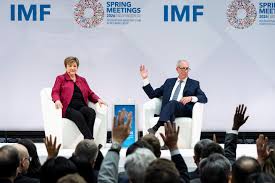
The International Monetary Fund (IMF) has cut its global economic growth forecast, citing escalating tensions between the United States and Iran that have driven up energy and food prices worldwide.
In its latest update released Tuesday, the IMF projected global growth at 3.1 percent for the year, down from its earlier estimate of 3.3 percent issued before the US and Israel launched their war on Iran on February 28.
The downgrade also reflects a slowdown from last year’s 3.4 percent expansion, with the IMF warning that the economic impact will vary significantly across regions.
The conflict has intensified following Iran’s closure of the Strait of Hormuz a vital route for global oil and gas shipments and attacks on key energy infrastructure. These disruptions have pushed up oil prices and tightened supply, hitting import-dependent economies particularly hard.
Among the hardest-hit countries, Iran recorded one of the steepest revisions, with its 2026 growth outlook slashed by 7.2 percentage points from earlier projections. Saudi Arabia also saw its GDP growth forecast reduced from 4.5 percent to 3.1 percent.
“The current hostilities in the Middle East pose immediate policy trade-offs: between fighting inflation and preserving growth, and between supporting those affected by rising living costs and rebuilding fiscal buffers,” the IMF said in its World Economic Outlook report.
IMF Chief Economist Pierre-Olivier Gourinchas noted that the economic strain would be uneven, disproportionately affecting countries in the conflict zone, commodity-importing low-income nations, and emerging markets.
Regional projections were also revised downward. Growth in the Middle East and North Africa for 2026 is now expected at 1.1 percent, a 2.8 percentage point cut, while the Middle East and Central Asia region saw its forecast reduced by 2 points to 1.9 percent.
In Europe, the eurozone economy is now expected to grow by 1.1 percent this year, down from 1.4 percent in 2025 and below the 1.3 percent forecast made in January.
Despite the grim outlook, there are signs of potential relief in energy markets. Oil prices fell on Tuesday amid hopes that Iran may resume negotiations with the United States to end the conflict.
Brent crude dropped 4.37 percent to $95.02 per barrel, while West Texas Intermediate fell 7.32 percent to $91.84. However, both benchmarks remain significantly higher than pre-war levels.