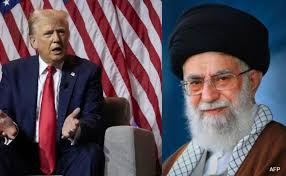
Oil prices fell sharply while global stock markets rebounded after former U.S. President Donald Trump said the United States and Iran had held talks aimed at ending the Middle East conflict, a claim swiftly denied by Tehran.
Brent crude prices dropped after Trump said the U.S. and Iran had discussed a “complete” resolution to hostilities and that planned strikes on Iranian power plants would be postponed for five days.
However, Iranian state-affiliated media insisted no talks had taken place between the two countries.
Trump had earlier warned he would “obliterate” Iranian power plants if the Strait of Hormuz shipping route was not reopened within 48 hours, while Iran threatened retaliation against key infrastructure across the region. The escalating rhetoric had rattled global financial markets over the weekend.
At one point on Monday, Brent crude rose to about $113 per barrel before falling sharply following Trump’s latest comments. Prices dropped to around $96 per barrel before recovering to roughly $103.
While oil prices fell, stock markets surged. London’s FTSE 100 index recovered to trade about 0.3% higher after earlier losses of more than 2%. Germany’s DAX index rose 1.7% and France’s CAC 40 gained 1.2%. In the United States, both the S&P 500 and the Dow Jones opened roughly 2% higher.
Asian markets, which closed before Trump’s comments, recorded heavy losses, with Japan’s Nikkei falling 3.5% and South Korea’s Kospi dropping 6.5%, reflecting concerns over energy supply disruptions. Both countries rely heavily on oil and gas shipments through the Strait of Hormuz, one of the world’s busiest energy shipping routes.
Since the conflict began on February 28, Iran has effectively blocked the waterway, through which about 20% of the world’s oil and liquefied natural gas normally passes, pushing global fuel prices higher.
In a post on Truth Social, Trump said the U.S. and Iran had held “very good and productive” discussions over a “complete and total resolution of our hostilities,” and he ordered a temporary pause on strikes against Iranian energy infrastructure pending the outcome of ongoing discussions.
However, Iran strongly denied the claim. The country’s foreign ministry said no negotiations direct or indirect had taken place with the United States. Iranian state broadcaster Press TV described the U.S. claims as “psychological warfare,” suggesting Washington was attempting to shape global perception of the conflict.
Iranian officials also suggested the shift in tone from Washington may have been driven by mounting military and economic pressure rather than any diplomatic progress.
The conflicting statements from Washington and Tehran have created uncertainty in global markets, with investors unsure whether diplomatic efforts are actually underway or simply being portrayed publicly.
Market analysts warned that despite the drop in oil prices, energy costs remain high. With oil still above $100 per barrel, companies and consumers are expected to continue facing high energy costs.
The conflict has already disrupted global energy supplies and raised fears of a major energy crisis.
The head of the International Energy Agency warned earlier that the world could face its worst energy crisis in decades, comparing the situation to the oil crises of the 1970s and the impact of Russia’s invasion of Ukraine in 2022.
Meanwhile, the UK government is holding emergency meetings to assess energy security and supply chain risks, as the conflict continues to affect global markets and the cost of living.