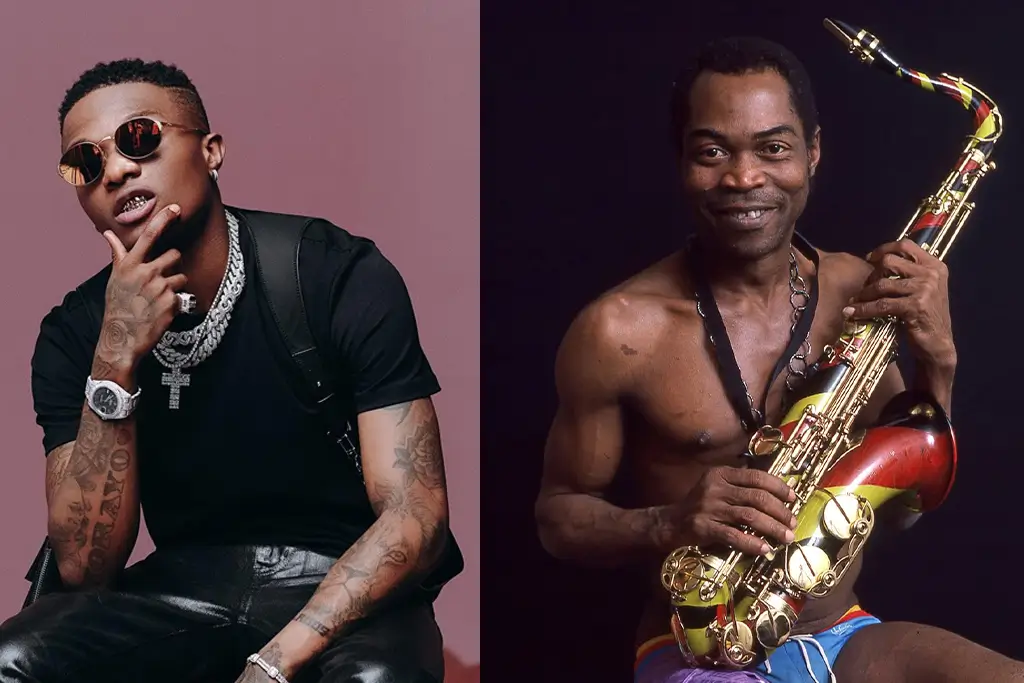
The Cultural Debate Between Seun Kuti and Wizkid Over the meaning of Greatness took social media by storm over comments attributed to Wizkid by Suen Kuti that his late father and founder of Afrobeats Fela Kuti, has no comparison to any living person in his genre of music and with Wizkid not coming close to such fame.
That said, hell was let loose as both Wizkid and his fans went berserk on social media to counter such a statement by Seun Kuti.
By any standard, Nigeria is no stranger to cultural debates. yet few arguments have stirred as much passion in recent times as the one sparked by comments from Seun Kuti regarding comparisons between his father, Afrobeat pioneer Fela Aníkúlápó Kuti, and contemporary Afrobeats superstar Ayo Balogun aka Wizkid.
The noise that followed from supporters of both camps was rather befuddling, never has there been such an online debate as the one trending between two Nigerian artistes as seen today.
One of the reasons for this was that never has it been said or heard that Fela Anikulapo legacies were being contested by another Nigerian artiste who wasn’t even born when he reigned and had his name mentioned the world over.
What began as an online exchange quickly evolved into a broader national conversation one that goes beyond music and touches on history, identity, and how greatness is defined in modern Nigeria.
At the centre of the controversy lies a seemingly simple question: who is bigger
Fela Kuti or Wizkid? But beneath that question is a far more complex debate about legacy versus popularity, activism versus entertainment, and ideology versus global recognition.
How it all Began
The tension emerged after online commentators and fans suggested that Wizkid’s global success measured through international awards, record-breaking streams, and sold-out concerts had surpassed the influence of Fela Kuti.
To many younger Nigerians and Afrobeats enthusiasts, the claim appeared reasonable.
Wizkid is one of Africa’s most commercially successful musicians, a Grammy Award winner, and a global brand whose music has helped push Nigerian sound to the world stage.
Seun Kuti, however, strongly rejected the comparison. In several public remarks, he argued that equating Wizkid’s success with Fela’s legacy misunderstands who Fela was and what he stood for.
According to Seun, Fela’s impact cannot be measured by charts or accolades, as his contribution extended far beyond music into political resistance, social reform, and Cultural Revolution.
Fela Kuti: Music as Resistance
Fela Aníkúlápó Kuti was not merely an entertainer, he was a radical political voice during one of Nigeria’s most turbulent periods.
Through Afrobeat a genre he pioneered. Fela openly challenged military dictatorships, exposed corruption, criticized neo-colonialism, and confronted social injustice.
His activism came at a heavy personal cost. Fela was arrested multiple times, imprisoned, physically assaulted, and subjected to state sponsored violence.
The infamous military raid on his Kalakuta Republic in 1977 resulted in the death of his mother, Funmilayo Ransome-Kuti, a renowned women’s rights activist. Despite these risks, Fela remained unapologetically defiant.
To Seun Kuti, this willingness to confront power defines true greatness. From his perspective, Fela’s “bigness” lies in his courage, sacrifice, and enduring influence on political consciousness across Africa and the Black diaspora.
Wizkid and the Rise of Global Afrobeats
Wizkid represents a different era of Nigerian music and a different kind of success.
Emerging in the early 2010s, he became a leading figure in the global Afrobeats movement, collaborating with international artists and performing on some of the world’s biggest stages.
Unlike Fela, Wizkid does not position himself as a political activist. His music largely dwells on love, celebration, lifestyle, and African pride.
For many Nigerians, especially younger audiences, this represents progress a shift from narratives of struggle to ones of global excellence and soft power.
Wizkid’s achievements have helped reshape global perceptions of Nigerian music and culture. In that sense, his supporters argue, his influence is immense and deserving of recognition.
Seun Kuti’s Position
Seun Kuti’s response to the comparison has often been interpreted as dismissive of Wizkid.
However, his argument is less about diminishing Wizkid’s success and more about preserving historical context.
Seun maintains that Fela’s legacy should not be evaluated using modern celebrity metrics.
According to him, comparing an artist who confronted military regimes to one who thrives within a global entertainment industry is fundamentally flawed. For Seun, the danger lies in equating commercial success with cultural or historical significance.
His stance reflects a broader concern that society increasingly celebrates fame without interrogating responsibility, activism, or sacrifice.
A Clash of Eras, Not Individuals
At its core, the debate reflects a clash between two eras of Nigerian expression. Fela belonged to a time when music served as a tool for resistance and survival. Wizkid belongs to a generation shaped by digital platforms, global markets, and cultural diplomacy.
Both eras have produced icons who responded to their realities in different ways. Fela confronted power directly. Wizkid navigates around it. One challenged the state; the other transcends borders.
Attempting to rank them using a single metric ignores these contextual differences.
Why the Debate Matters
The intensity of the argument reveals a deeper national tension about values. Should greatness be measured by global visibility or by moral courage? Does cultural influence require political engagement? Can joy and entertainment be forms of progress?
These questions resonate in a country still grappling with governance challenges, economic uncertainty, and generational divides. Seun Kuti’s defence of his father reflects a desire not to forget the sacrifices that shaped Nigeria’s cultural and political history while Wizkid’s popularity reflects a generation eager to redefine Nigeria’s image on its own terms.
Beyond the Question of “Who Is Bigger?”
Framing the discussion as a competition risks oversimplifying two monumental legacies. Fela did not create music to dominate charts, and Wizkid did not seek fame to replace political activism. Their contributions exist in different dimensions.
Fela transformed consciousness. Wizkid transformed perception.
One challenged injustice from within Nigeria. The other projects Nigerian culture to the world.
Conclusion
The feud between Seun Kuti and Wizkid’s supporters is less about ego and more about interpretation.
It highlights how societies remember their heroes and how definitions of greatness evolve over time.
Rather than asking who is bigger, a more productive question may be what each figure represents and what Nigeria needs from its artists at different moments in history.
Wizkid is generally considered bigger in terms of modern commercial success, global streaming, and chart dominance, with over 10 billion Spotify streams and record-breaking sales.
Fela Kuti on the other hand is viewed as unmatched in historical significance, impact, and activism, representing different eras of greatness.
Key Comparisons:
- Wizkid’s Dominance: He is the first African artist to hit major Spotify milestones (1–10 billion streams). He has sold out international venues like the Tottenham Hotspur Stadium.
- Fela’s Legacy: Fela’s influence is rooted in his creation of Afrobeat and his role as a cultural icon, rather than modern streaming metrics.
- Context: While some discussions compare the two, others emphasize that they operate in different, incomparable eras.
In that sense, both Fela Kuti and Wizkid occupy essential places in Nigeria’s cultural story.
One reminds the nation of its struggles and responsibilities; the other showcases its creativity and global relevance.
Together, they reflect the complexity, resilience, and dynamism of Nigerian identity that has reshaped African Music genre when Afrobeats is mentioned on the global music stage .