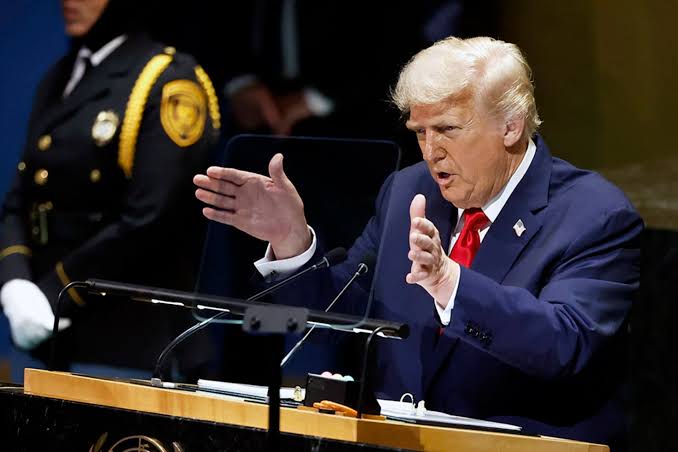
US President says Washington has no immediate plans to intensify military operations against Tehran, but insists Iran must accept a strong agreement over its nuclear programme and regional security.
US President Donald Trump has said he sees no reason to escalate the ongoing war with Iran, signalling a possible shift towards diplomacy as Washington and Tehran continue efforts to negotiate an agreement to end the conflict.
Trump made the remarks during an interview with CBS News’ 60 Minutes, aired on Sunday, where he was asked whether he intended to intensify military operations against Iran following the recent developments in the conflict.
“Well, I’m not looking to. I don’t think there’s any reason to,” the president said, suggesting that his administration was not presently considering a broader military offensive against Tehran.
However, Trump defended his decision to launch the war in February, describing it as a move that history would eventually recognise as beneficial to American security, despite the economic consequences currently being experienced by the United States and other countries.
“I think, historically, this will be a very good decision. Is it a good decision for today and tomorrow? Maybe not,” he said.
The American president maintained that Iran’s nuclear ambitions were the principal justification for the military campaign, arguing that preventing Tehran from acquiring nuclear weapons remained a major national security priority for Washington.
His comments come amid growing international concerns over the economic and geopolitical consequences of the conflict, particularly disruptions to shipping activities around the strategically important Strait of Hormuz.
The waterway, which connects the Persian Gulf to international markets, is a critical passage for global oil supplies. The conflict and restrictions on maritime movements have contributed to uncertainty in energy markets, raising concerns about fuel prices and international trade.
Trump’s latest position also comes as diplomatic efforts intensify, with Qatar playing a significant mediating role between Washington and Tehran.
The American president is expected to meet Qatari Prime Minister Sheikh Mohammed bin Abdulrahman Al Thani at the White House on Monday. Qatar has been facilitating indirect negotiations aimed at securing an agreement that could bring an end to hostilities.
Nevertheless, the prospects of an immediate breakthrough remain uncertain.
US Secretary of State Marco Rubio has cautioned against expectations of a rapid diplomatic settlement, saying the negotiations were not yet close to producing an agreement.
Rubio attributed the difficulties to what Washington considers unacceptable demands from Iran, although he maintained that the Trump administration preferred a diplomatic resolution.
Meanwhile, Trump has continued to apply economic and military pressure on Tehran through a naval blockade and the newly announced Task Force Iron Gate, designed to restrict the movement of military technology and revenue-generating goods through Iran’s trade routes.
The president said the task force was already operational, describing the blockade as an important instrument for compelling Iran to reconsider its position.
Despite expressing reluctance to escalate the war, Trump has not completely ruled out further military action if negotiations collapse.
He has previously warned that American forces have identified strategic infrastructure targets, including bridges and power facilities, which could be attacked if hostilities resume.
The developments have placed additional pressure on diplomatic efforts to prevent another round of military confrontation.
For Iran, the central issues reportedly include the lifting of American sanctions, the release of frozen assets, compensation for wartime destruction and guarantees against renewed attacks.
Washington, on the other hand, wants firm commitments concerning Iran’s nuclear programme and security arrangements around the Strait of Hormuz.
As both countries continue to exchange demands, international observers are watching closely to determine whether Trump’s latest comments will translate into a lasting diplomatic breakthrough.
For now, his declaration that there is no reason to escalate the conflict offers a measure of hope that negotiations could prevent another devastating phase of the war, although the continued military pressure on Iran suggests that the confrontation is far from over.