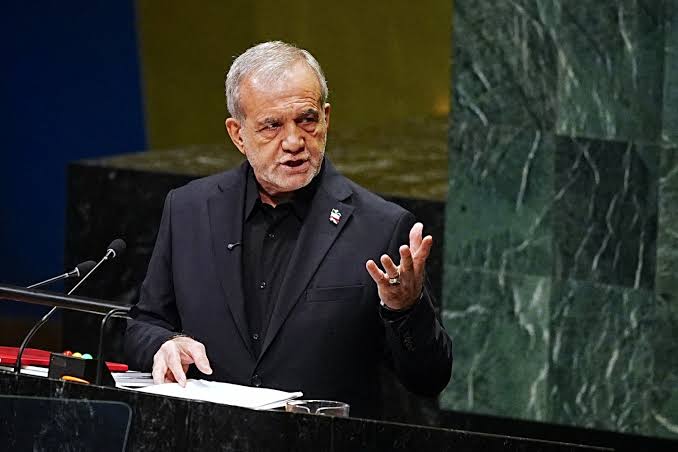
Iranian President Masoud Pezeshkian says Tehran does not want negotiations with Washington delayed until after the November U.S. midterm elections, calling for the revival of a previous memorandum of understanding.
Iranian President Masoud Pezeshkian has said Tehran wants to reach an agreement with the United States before the November midterm elections, challenging President Donald Trump’s assertion that Iran is waiting until after the vote before making a deal.
Speaking Thursday on the sidelines of the United Nations General Assembly in New York, Pezeshkian said Iran would prefer Washington to return to a memorandum of understanding (MOU) reached in June that provided a framework for a temporary ceasefire between the two sides.
“We don’t want it to get to the midterm elections,” Pezeshkian told NBC News and other media organisations. He added: “We wish Americans to return to the MOU before the midterms.”
The comments come amid renewed diplomatic contacts between Washington and Tehran as the two countries remain embroiled in a prolonged conflict. Iranian officials have signaled that they are prepared to negotiate, while the Trump administration has continued to demand major changes to Iran’s nuclear programme and broader regional activities.
The June understanding subsequently collapsed, with the two sides accusing each other of failing to uphold its terms.
Pezeshkian’s latest remarks therefore appear to represent an effort to reopen a diplomatic channel rather than confirmation that a comprehensive agreement has already been reached.
The Iranian president also indicated that Tehran remains open to international inspections of its nuclear facilities, an issue likely to be central to any future negotiations. Iran has consistently maintained that its nuclear programme is peaceful, while the United States has insisted that Tehran must not acquire a nuclear weapon.
Pezeshkian’s proposal contrasts with Trump’s recent public comments. During his address to the UN General Assembly on September 22, Trump said he believed an agreement with Iran could be reached after the midterm elections.
Reuters reported that Trump had expressed confidence in a post-election diplomatic settlement despite Iranian overtures for renewed negotiations.
The disagreement over timing is significant because the U.S. midterm elections are scheduled for November 3.
A diplomatic breakthrough before the elections could alter the political and economic environment surrounding the conflict, while failure to reach an understanding could leave negotiations facing a new political timetable.
Another major issue in the discussions is the Strait of Hormuz, one of the world’s most important oil shipping routes.
Iranian officials have indicated that Tehran could reopen the strategic waterway if Washington eases military pressure and lifts its blockade of Iranian ports. Reuters reported that an Iranian proposal for ending hostilities had been transmitted to the United States through mediators.
Recent reports also indicate that American and Iranian negotiators in New York are examining a possible phased arrangement involving the Strait of Hormuz and the U.S. economic blockade.
Such discussions could provide a pathway toward broader negotiations on Iran’s nuclear programme and the wider conflict.
For now, however, Pezeshkian’s statement represents an expression of Tehran’s preferred diplomatic timetable rather than evidence that an agreement is imminent.
The contrasting positions from Washington and Tehran leave the next steps dependent on whether both governments can bridge their differences over the nuclear programme, sanctions, military activity and regional security.