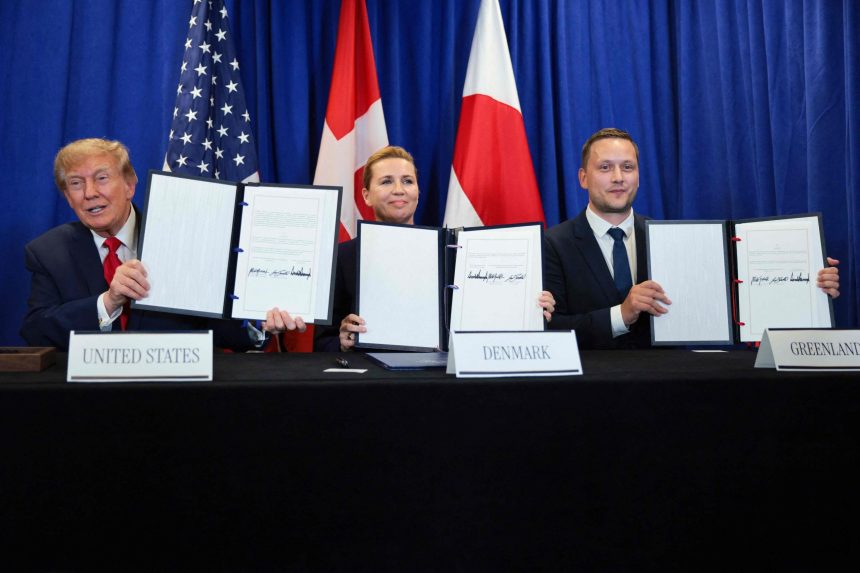
US President Donald Trump has signed a landmark security agreement with Denmark and Greenland aimed at strengthening American and allied defence capabilities across the Arctic and North Atlantic, bringing an end to months of diplomatic tensions over the strategically important island.
Trump signed the agreement on September 22, 2026, alongside Danish Prime Minister Mette Frederiksen and Greenland Prime Minister Jens-Frederik Nielsen during the United Nations General Assembly in New York.
The agreement must still undergo the necessary national parliamentary procedures before entering into force.
The 10-page pact provides for an expanded US military presence in Greenland, including the development of defence facilities at Narsarsuaq in southern Greenland and Mestersvig on the island’s eastern coast.
It also permits the United States to modernise and expand activities at Pituffik Space Base, the existing US military installation in northwestern Greenland.
The agreement marks a significant change in the security arrangements surrounding Greenland, whose location between North America and Europe makes it strategically important for missile warning, space operations, Arctic surveillance and control of emerging northern sea routes.
Washington has increasingly focused on the Arctic as competition with Russia and China intensifies.
The agreement restricts non-NATO countries from establishing military facilities or maintaining a permanent military presence in Greenland unless the parties agree otherwise.
The pact also addresses one of the most contentious issues surrounding Trump’s Greenland policy.
Although the US president has repeatedly advocated greater American control over the territory, the new agreement does not transfer sovereignty over Greenland to Washington.
Instead, the document explicitly recognises the sovereignty and territorial integrity of the Kingdom of Denmark while acknowledging the Greenlandic people’s right to self-determination.
Danish Prime Minister Frederiksen said the agreement strengthens security while respecting both principles.
For Greenland, the deal represents an effort to secure greater involvement in Arctic security while retaining its existing constitutional position within the Kingdom of Denmark. Greenland’s Prime Minister Nielsen described the agreement as strengthening shared security and reaffirming Greenland’s position within the Western alliance.
Trump hailed the agreement as a major step for American security, saying it gives the United States lasting control over security interests necessary to defend North America.
The White House said the arrangement also prevents US adversaries from establishing military or strategically sensitive footholds in Greenland.
The agreement follows months of uncertainty after Trump’s campaign to increase US control over Greenland generated concern in Copenhagen and Nuuk and strained relations among members of the NATO alliance.
The signing at the UN therefore carries significance beyond the Arctic. It demonstrates an attempt by Washington, Copenhagen and Nuuk to convert a major diplomatic dispute into a formal security partnership.
NATO Secretary-General Mark Rutte welcomed the agreement, saying it complements the alliance’s growing role in securing the Arctic region.
As climate change opens new Arctic shipping routes and competition over strategic resources grows, Greenland is becoming increasingly important to global security calculations.
The new US-Denmark-Greenland agreement places the island firmly at the centre of that emerging geopolitical contest while leaving its sovereignty formally unchanged.