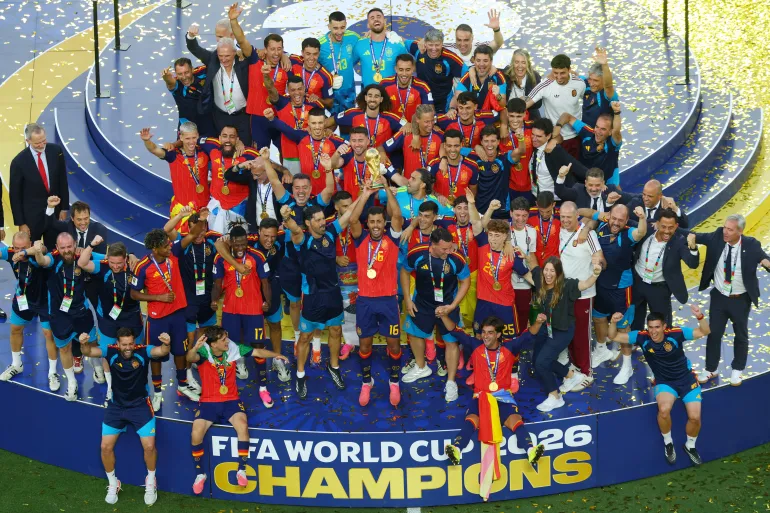
Spain reclaimed football’s greatest prize in dramatic fashion, defeating defending champions Argentina 1-0 after extra time in a tense FIFA World Cup final that will be remembered as much for tactical brilliance as for individual heroics.
Ferran Torres emerged as Spain’s unlikely match-winner, striking deep into extra time after Lionel Messi and Argentina had been frustrated for more than two hours by one of the finest defensive performances seen on the world’s biggest stage.
The victory secured Spain’s second World Cup title, adding to the crown they first won in South Africa in 2010, while ending Argentina’s dream of defending the trophy they lifted four years earlier.
It also marked what could be the final World Cup appearance of Messi, whose quest to add another global title ended in heartbreak.
From the opening whistle, Spain made their intentions clear.
Rather than allowing Argentina’s captain time to dictate the tempo, Luis de la Fuente’s side swarmed Messi every time he received possession.
Midfielders Martín Zubimendi, Rodri and Pedri worked tirelessly to close passing lanes, while defenders Robin Le Normand and Pau Cubarsí stepped out confidently whenever Messi attempted to drift between the lines.
The strategy worked almost perfectly.
Messi, whose creativity had inspired Argentina throughout the tournament, found himself surrounded by two or three Spanish shirts whenever he touched the ball. Forced deeper into midfield to find possession, the eight-time Ballon d’Or winner struggled to influence the contest in dangerous areas.
Argentina, however, remained dangerous on the counterattack. Julián Álvarez twice tested Spain goalkeeper Unai Simón in the opening half, while Alexis Mac Allister narrowly missed the target with a curling effort after capitalizing on a rare Spanish defensive mistake.
Spain dominated possession, patiently circulating the ball through Rodri and Pedri while Nico Williams and Lamine Yamal stretched Argentina’s defense on both flanks. Despite their territorial advantage, clear-cut opportunities remained scarce as Cristian Romero and Lisandro Martínez produced a series of crucial interceptions.
The first half ended scoreless, reflecting a fascinating tactical battle rather than a lack of ambition.
Spain increased the intensity after the restart, with Yamal repeatedly tormenting Argentina’s left flank through his pace and dribbling. Álvaro Morata thought he had broken the deadlock just after the hour mark, only for his effort to be ruled out for offside following a lengthy VAR review.
Argentina gradually found their rhythm in the closing stages of normal time. Messi produced one of his few trademark moments in the 78th minute, gliding past two defenders before slipping a perfectly weighted pass into Álvarez, whose shot was brilliantly saved by Simón.
As fatigue began to set in, both managers turned to their benches in search of fresh inspiration. Spain introduced Ferran Torres and Mikel Merino, while Argentina responded with fresh attacking options in an attempt to steal victory before penalties.
The breakthrough finally arrived in the 112th minute.
Spain launched another patient move from midfield, with Pedri exchanging quick passes before releasing Yamal into space down the right.
The teenage sensation delivered a low cross into the penalty area, where Ferran Torres timed his run perfectly to beat his marker and sweep the ball first-time beyond Emiliano Martínez.
The Spanish bench erupted as Torres sprinted toward the corner flag, embraced by teammates who knew they were only minutes away from football immortality.
Argentina desperately searched for an equalizer in the remaining minutes.
Messi delivered a dangerous free-kick into the box, while Martínez came forward for a late corner, but Spain’s defense held firm under immense pressure.
When the final whistle sounded, Spanish players collapsed onto the pitch in celebration after completing a remarkable tournament that saw them eliminate Portugal, Belgium, France and finally Argentina on their way to lifting the trophy.
For Argentina, the defeat brought an end to an extraordinary campaign built on resilience.
The defending champions had recovered from difficult moments throughout the knockout rounds, defeating Egypt, Switzerland and England to reach another final. Yet against Spain’s suffocating pressing game, they never found the attacking rhythm that had carried them through previous rounds.
Messi left the field to a standing ovation from supporters of both nations. Although denied another World Cup triumph, the Argentine icon once again demonstrated his enduring influence throughout the tournament, leading his nation to a second consecutive final and reinforcing his place among football’s greatest players.
Spain’s triumph reflected the emergence of a new generation of stars blending seamlessly with experienced campaigners. Rodri controlled midfield with authority, Pedri orchestrated attacks with elegance, while teenage winger Lamine Yamal confirmed his status as one of world football’s brightest talents with another dazzling performance on the biggest stage.
Yet it was Ferran Torres who etched his name into Spanish football folklore. His composed finish under immense pressure delivered the game’s only goal and ensured Spain would once again stand atop world football.
As confetti rained down and captain Álvaro Morata lifted the World Cup trophy before a jubilant sea of red and gold, Spain celebrated not only a championship but also a tactical masterclass that neutralized Lionel Messi, outlasted Argentina and restored La Roja to the summit of the global game.