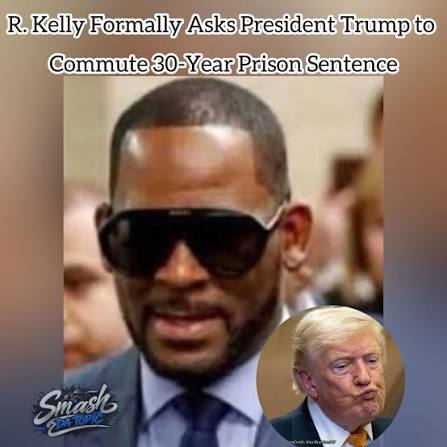
R&B singer R. Kelly has formally petitioned U.S. President Donald Trump to commute his 30-year federal prison sentence, marking the latest chapter in the disgraced musician’s prolonged legal fight.
According to court records released this week by the Office of the Pardon Attorney, Kelly’s application for executive clemency is currently pending.
The request, first reported by the Chicago Tribune, is for a commutation of his sentence rather than a full presidential pardon.
A commutation would reduce or end Kelly’s prison term but would leave his criminal convictions intact, unlike a pardon, which forgives the offense and restores certain civil rights.
Kelly, whose full name is Robert Sylvester Kelly, is serving a 30-year prison sentence following his 2022 conviction on federal racketeering and sex trafficking charges in New York.
He was later convicted in Chicago on child pornography-related charges and received an additional prison sentence, much of which is being served concurrently with his New York sentence.
His latest appeal for clemency comes just over a year after his attorney, Beau Brindley, filed an emergency motion seeking Kelly’s immediate release from federal custody to home detention.
At the time, Brindley argued that the singer’s life was in danger while incarcerated and accused federal authorities of misconduct in handling his imprisonment.
Those claims were strongly disputed by the U.S. government, which maintained that Kelly was being housed under appropriate security measures and that there was no legal basis for his release. Federal prosecutors have consistently defended both Kelly’s conviction and the conditions of his incarceration.
The newly disclosed clemency application does not provide detailed legal arguments but signals that Kelly is now pursuing one of the few remaining avenues available after exhausting many of his traditional appeals.
Applications submitted to the Office of the Pardon Attorney are reviewed before recommendations are made to the president, who ultimately has broad constitutional authority to grant or deny clemency for federal offenses.
Legal experts note that a presidential commutation differs significantly from overturning a conviction through the courts. Even if granted, Kelly would remain a convicted felon, and the judgments against him would continue to stand.
Kelly’s legal team has repeatedly argued that his prosecution was flawed and that he has been unfairly treated throughout the judicial process.
They have also maintained that the singer’s health and safety have been compromised during his imprisonment.
The singer’s fall from grace has been one of the most dramatic in modern entertainment.
Once among the most successful figures in contemporary R&B, Kelly produced a string of chart-topping hits throughout the 1990s and early 2000s, including “I Believe I Can Fly,” “Bump N’ Grind,” and “Ignition (Remix).” His commercial success earned him multiple Grammy Awards and millions of album sales worldwide.
However, allegations of sexual abuse involving underage girls followed him for decades.
Public scrutiny intensified after the release of the 2019 documentary series Surviving R. Kelly, which featured detailed accounts from numerous women who accused the singer of abuse, coercion and exploitation.
The series renewed public pressure on law enforcement and ultimately contributed to renewed criminal investigations.
In September 2021, a federal jury in Brooklyn convicted Kelly on racketeering and sex trafficking charges after prosecutors argued that he used his fame and inner circle to recruit and exploit young women and girls over many years. He was sentenced to 30 years in prison in June 2022.
A separate federal jury in Chicago later found him guilty of multiple child pornography offenses and enticement charges.
Although he received additional prison time, the sentences were structured so that much of the punishment overlaps with his existing federal term.
Kelly has continued to challenge both convictions through the appeals process. While some legal arguments have been rejected, his attorneys have maintained that further review is warranted and have continued filing motions in federal courts.
The decision on his commutation request now rests entirely with President Trump, who has constitutional authority to grant clemency in federal criminal cases.
During both of his terms in office, Trump has exercised that authority in several high-profile cases involving politicians, business executives, celebrities and other federal inmates, although each application is evaluated individually.
At present, there is no indication that the White House has acted on Kelly’s request or whether it is under active consideration.
The Office of the Pardon Attorney lists the application as pending, and neither Trump’s office nor the Department of Justice has publicly commented on the matter.
For now, Kelly remains incarcerated while awaiting the outcome of both his clemency petition and any remaining legal appeals.
Whether the request results in a reduced sentence or is ultimately denied, the filing underscores the limited legal options left for the once-celebrated singer as he continues serving one of the most consequential prison terms imposed on a major figure in the music industry.