South Africa says it has processed more than 53,000 undocumented foreign nationals for deportation and repatriation as part of an intensified nationwide migration campaign, marking one of the country’s largest immigration enforcement operations in recent years.
The announcement comes amid mounting public concern over illegal immigration, high unemployment, and rising anti-foreigner sentiment that has triggered protests and, in some cases, violent attacks on migrant communities across the country.
Justice and Constitutional Development Minister Mmamoloko Kubayi, who chairs the government’s Inter-Ministerial Committee (IMC) on Migration, said that 53,449 foreign nationals had been processed for deportation by the close of business on July 11.
According to the government, the operation forms part of a broader strategy announced by President Cyril Ramaphosa in June to tighten border security, improve migration management and crack down on undocumented migration.
Authorities say the campaign is being coordinated by the Department of Home Affairs, the Border Management Authority, the South African Police Service and other law enforcement agencies.
President Ramaphosa previously acknowledged growing public concern over illegal immigration, saying government would strengthen enforcement while insisting that immigration laws must be applied within constitutional and legal frameworks.
The president also announced plans to establish dedicated immigration courts to speed up deportation proceedings, recruit thousands of additional labour inspectors and impose tougher penalties on employers found hiring undocumented migrants illegally.
Authorities say more than 450,000 attempted illegal border crossings have been intercepted over the past year.
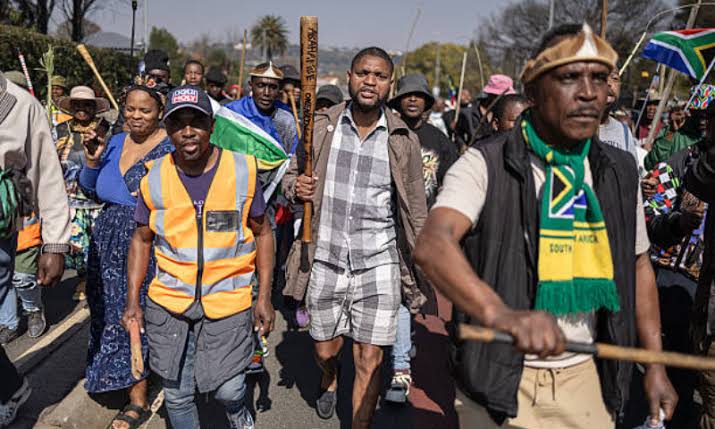
The migration campaign has unfolded against a backdrop of increasingly vocal anti-immigration demonstrations in Johannesburg, Soweto, Durban and other parts of South Africa.
Reuters reported that protesters have gone beyond demonstrations in some communities, conducting door-to-door searches for suspected undocumented migrants and handing some over to police.
Rights organizations have condemned the actions as unlawful vigilantism and warned they risk fueling xenophobic violence reminiscent of previous outbreaks that have periodically shaken Africa’s most industrialized economy.
Government officials have repeatedly stressed that immigration enforcement remains the responsibility of the state, warning citizens not to take the law into their own hands.
The Inter-Ministerial Committee has insisted that while the government is committed to removing undocumented migrants, it will also protect both South African citizens and foreign nationals from intimidation and violence.
South Africa hosts one of Africa’s largest migrant populations, attracting workers from neighboring Zimbabwe, Mozambique, Malawi, Lesotho and elsewhere due to its relatively diversified economy.
However, years of sluggish economic growth, persistent power shortages and unemployment exceeding 30 percent have intensified frustrations among many South Africans, with undocumented migration increasingly becoming a politically sensitive issue.
Economists and migration experts caution that large-scale departures of migrant workers could create unintended economic consequences.
Reuters noted that migrants play significant roles in sectors including agriculture, construction, logistics, retail and hospitality.
Studies cited by international organizations suggest migrants contribute meaningfully to South Africa’s economy and are not the primary cause of unemployment, despite widespread public perceptions to the contrary.
The recent unrest has already prompted tens of thousands of migrants, particularly from Malawi and Zimbabwe, to leave South Africa voluntarily amid fears for their safety.
Some neighboring governments have organized repatriation efforts for their citizens.
Nigeria has also raised concerns after reporting that two of its nationals died during the recent wave of anti-migrant unrest, prompting diplomatic exchanges between Abuja and Pretoria.
South African authorities have maintained that allegations surrounding the deaths are under investigation while calling for evidence to be shared through official diplomatic channels.
Meanwhile, South Africa’s Parliament has praised the operational efficiency of a temporary repatriation processing centre in Musina, Limpopo, describing it as central to handling the surge in deportation cases while ensuring legal procedures are followed.
As deportations continue and immigration remains at the forefront of South Africa’s political debate, the government faces the difficult challenge of balancing border enforcement, constitutional protections and economic realities, while preventing anti-foreigner sentiment from escalating into wider violence.