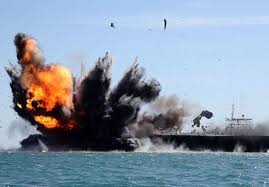
The United States has launched a new wave of military strikes against Iranian targets, marking another dangerous escalation in the rapidly deteriorating confrontation between Washington and Tehran over control of the strategically vital Strait of Hormuz.
According to reports from international publications including The Wall Street Journal, Reuters, The Associated Press,and PBS News, U.S. forces carried out multiple airstrikes against Iranian missile launch sites, drone facilities and military infrastructure after Iran allegedly attacked commercial shipping operating near the Strait of Hormuz.
U.S. Central Command (CENTCOM) said the strikes were intended to reduce Iran’s ability to threaten international shipping and protect freedom of navigation through the narrow waterway, which serves as one of the world’s most important energy corridors.
The latest operation follows several days of mounting tensions after Iran declared that it was closing the Strait of Hormuz, a move rejected by Washington and many Western allies.
Tehran has insisted it has sovereign authority to regulate traffic through the strategic passage, while the United States argues that international maritime law guarantees free navigation through the strait.
Iran responded swiftly to the American strikes by launching missiles and drones toward countries hosting U.S. military forces across the Gulf, including Bahrain, Kuwait, Qatar, Jordan, Oman and the United Arab Emirates.
Several countries activated their air defence systems to intercept incoming projectiles, while authorities reported limited damage and injuries in some locations.
Military analysts say the latest exchanges represent one of the most dangerous phases in the ongoing U.S.-Iran confrontation, raising fears that the conflict could expand well beyond the Persian Gulf.
The Strait of Hormuz carries roughly one-fifth of the world’s seaborne oil exports, making it indispensable to global energy markets.
Any prolonged disruption could send crude oil prices sharply higher, increase shipping insurance costs and place additional pressure on economies already grappling with inflation and supply chain challenges.
Shipping companies have already begun reassessing routes through the Gulf as security risks intensify.
Maritime monitoring organizations reported that while Iran declared the waterway closed, vessels continue to transit using southern shipping lanes under heavy military protection. However, operators remain on high alert following recent attacks on commercial vessels.
President Donald Trump defended the latest military action, saying the United States would continue protecting international shipping and would not allow Iran to dictate access to one of the world’s busiest maritime trade routes.
American officials said the operation was carefully targeted at military assets directly linked to attacks on commercial shipping and stressed that Washington was not seeking a broader war, although it remained prepared to respond to any further Iranian aggression.
Tehran, however, condemned the strikes as a violation of previous diplomatic understandings and accused Washington of sabotaging months of negotiations aimed at reducing tensions in the Gulf. Iranian officials warned that further attacks would trigger stronger retaliation against American interests and regional allies.
Diplomatic efforts to contain the crisis appear increasingly fragile. Mediation attempts by Gulf states and regional partners have so far failed to restore confidence between the two adversaries, while negotiations over maritime security and broader regional issues remain stalled.
The United Nations and several European governments have urged both countries to exercise restraint, warning that continued military escalation could destabilize the wider Middle East and disrupt global energy supplies.
International leaders have repeatedly emphasized the importance of keeping the Strait of Hormuz open for commercial navigation and avoiding actions that could trigger a larger regional conflict.
Financial markets are closely monitoring developments. Oil prices climbed after news of the latest strikes, reflecting investor concerns that prolonged instability around the Strait of Hormuz could significantly affect global energy supplies. Analysts say continued military exchanges between the United States and Iran are likely to keep energy markets volatile in the coming weeks.
With both sides showing little sign of backing down, the confrontation has entered a dangerous new phase.
As military operations continue and diplomatic channels struggle to gain traction, the international community faces growing concern that the world’s most important energy corridor could become the center of an even wider geopolitical crisis.