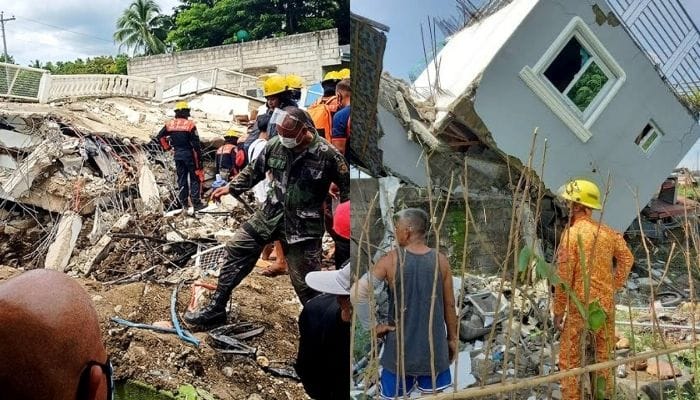
The Philippines is grappling with the aftermath of one of its most powerful earthquakes in recent years after a magnitude 7.8 quake struck off the coast of the southern island of Mindanao, leaving at least 32 people feared dead and dozens more injured.
The powerful tremor, which struck early Monday morning about 20 kilometres off Sarangani province, sent shockwaves across Mindanao and was felt as far away as Indonesia’s Sulawesi island, triggering tsunami warnings in several countries and sparking widespread panic among residents.
As rescue workers searched through collapsed structures and landslide-hit communities, survivors recounted harrowing moments of fear as buildings shook violently and roads cracked beneath them.
In General Santos City, one of the hardest-hit areas and home to nearly 700,000 people, residents described the quake as unlike anything they had experienced before.
“It was the first time I experienced something that strong,” said 44-year-old tricycle driver Jojo Calma. “I couldn’t stop myself from crying. My thoughts immediately went to my children and my niece. I feared the worst.”
Calma was driving near a commercial building when it suddenly collapsed. Video footage released by local authorities showed the structure, which housed a fast-food restaurant, crumbling within seconds as terrified pedestrians and motorists fled from a rapidly spreading cloud of dust.
Although Calma’s children, who were attending school when the earthquake struck, escaped unharmed, his family’s relief was tempered by the destruction of his sibling’s home.
“Thank God they’re safe,” he said. “But many families have lost everything.”
The earthquake struck just as schools across the region were reopening after an extended break, raising fears for thousands of students and teachers. Dramatic footage shared online showed classrooms shaking violently as children clung to teachers before rushing to safety. In one video, a temporary shelter collapsed moments after students evacuated the area.
Authorities said preliminary reports indicated at least 32 deaths and 134 injuries across Mindanao, with many casualties linked to collapsing buildings, falling debris and landslides triggered by the powerful tremor.
The Philippine government immediately deployed military personnel, emergency responders and medical teams to affected communities as search-and-rescue operations intensified.
President Ferdinand Marcos Jr ordered a full-scale disaster response, directing government agencies to mobilise relief supplies, establish evacuation centres and prepare for further rescue efforts.
“The national government is moving and we will not leave Mindanao behind,” Marcos said in a statement.
For many residents, the disaster brought back painful memories of previous deadly earthquakes that have struck the archipelago. The Philippines, situated along the seismically active Pacific Ring of Fire, experiences hundreds of earthquakes every year.
Eight months ago, a magnitude 6.9 earthquake near the central island of Cebu claimed 79 lives, while a series of strong quakes later struck Mindanao, causing extensive destruction and displacement.
The latest disaster also generated concern across the wider Asia-Pacific region. Tsunami warnings were issued in the southern Philippines, northern Indonesia and Malaysia’s Sabah state, prompting emergency evacuations in vulnerable coastal communities.
Although the warnings were later lifted after more than six hours, authorities reported small tsunami waves in several locations. Japan recorded waves measuring up to 0.2 metres, leading to ferry disruptions and precautionary beach closures.
In Indonesia’s North Sulawesi province, tsunami waves reaching 0.75 metres were detected in some areas, prompting residents to move to higher ground. Communities on the remote Sangihe Islands, among the closest Indonesian territories to the Philippines, were placed on alert.
Back in General Santos City, many residents faced another challenge after surviving the quake: the loss of essential services.
“When I got home, there was no electricity and no water,” said 30-year-old tricycle driver Jayson Manarca. “We are all affected. We don’t even have drinking water.”
Hospitals and public facilities also suffered damage. One hospital was evacuated after cracks appeared on upper floors, while part of Notre Dame of Dadiangas University collapsed. Fortunately, no one was inside the building at the time.
Disaster officials said ongoing aftershocks have complicated rescue efforts and delayed structural assessments. More than 200 aftershocks have been recorded, including at least nine powerful tremors felt across Mindanao. The strongest registered a magnitude of 6.7.
In Sarangani province, the quake struck during a police flag-raising ceremony. According to local police chief Benjie Ancheta, several people fainted as the ground shook violently beneath them.
Across affected communities, shattered glass, twisted metal and piles of concrete now serve as grim reminders of the earthquake’s destructive force. Businesses remain closed, schools have suspended classes and thousands of families are assessing the damage to their homes.
International agencies, including the United States Tsunami Warning System, continue to monitor developments as humanitarian organisations coordinate relief assistance for affected communities.
As night fell over Mindanao, many residents remained outdoors, fearful of returning to damaged buildings while aftershocks persisted. For survivors, the immediate challenge is not only rebuilding homes and infrastructure but overcoming the trauma of a disaster that struck without warning and changed lives in a matter of seconds.
With rescue teams still searching through debris and authorities warning that the death toll could rise, the Philippines now faces another difficult recovery from one of the strongest earthquakes to hit the region in recent years.