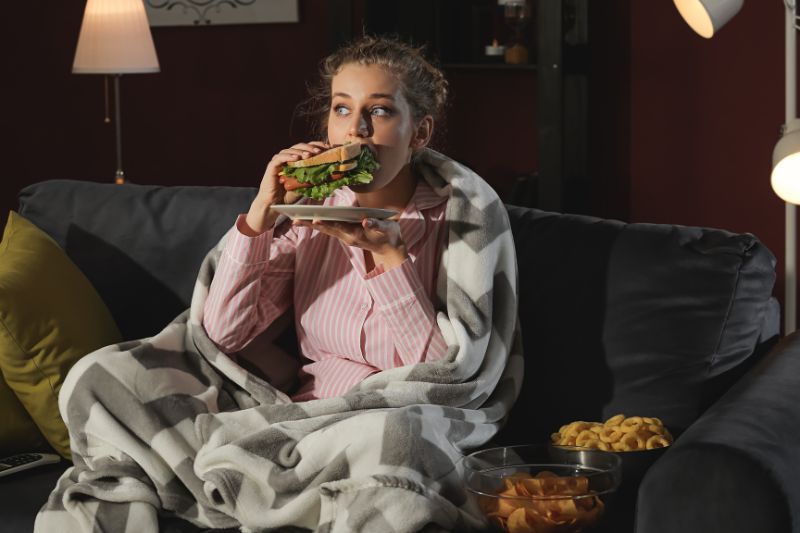
As modern lifestyles become increasingly demanding, late-night eating has become a common habit among millions of people worldwide. Whether driven by work schedules, social activities, or emotional stress, many individuals find themselves reaching for snacks long after dinner. However, emerging research suggests that consuming food after 9 p.m. may have more serious consequences than previously thought. Health experts are now warning that the combination of stress and late-night snacking can significantly compromise gut health.
The human digestive system operates according to the body’s internal clock, also known as the circadian rhythm. When food is consumed late at night, digestion becomes less efficient as the body prepares for rest. This disruption can affect the balance of beneficial bacteria in the gut, which play a crucial role in digestion, immunity, and overall health.
Stress further compounds the problem by triggering hormonal changes that influence appetite and food choices. Individuals under pressure are more likely to crave sugary, fatty, and highly processed foods, many of which are consumed late at night. Such eating patterns can promote inflammation, weaken the gut barrier, and contribute to digestive discomfort.
Researchers have linked habitual late-night eating to an increased risk of obesity, acid reflux, diabetes, and cardiovascular disease. Studies also suggest that an unhealthy gut microbiome may negatively affect mental health, creating a vicious cycle between stress, poor eating habits, and declining well-being.
As awareness grows about the importance of gut health, medical professionals are encouraging people to adopt healthier eating schedules, manage stress effectively, and avoid unnecessary late-night snacking. Experts believe that simple lifestyle changes could play a significant role in protecting digestive health and improving overall quality of life.
- When snacking, the quality and quantity of foods consumed may impact health.
- A recent study has found that the timing of snacking, particularly when late at night, can affect digestive health and the gut microbiome.
- This research, presented at Digestive Disease Week, also uncovers the relationship between late-night eating and chronic stress.
Is it the late hour, or the lifestyle and stress that push us toward it that makes snacking at night so unhealthy? Turns out, it may be a combination of both, which can affect not only our weight but also our gut health, including our microbiome.
Research presented at Digestive Disease Week (DDW) 2026 suggested that snacking takes a “double” toll on the digestive system, driven by the combination of chronic stress and late-night eating. This demonstrated how the body’s internal clock and stress levels work together to affect gut health.

Led by Harika Dadigiri, MD, resident physician at New York Medical College at Saint Mary’s and Saint Clare’s Hospital, New Jersey, the study suggests that when people eat may be just as important as what they eat.
The findings are yet to be published in a peer-reviewed journal.
Using two major datasets, the National Health and Nutrition Examination Survey (NHANESTrusted Source) and the American Gut Project, the research team led by Dadigiri identified a “chrononutrition-stress axis” that measures how stress levels affect our eating patterns and timing.
In the NHANES cohort, people who had levels of high stress and were late-night eaters were 39.3% more likely to experience abnormal bowel habits such as constipation or diarrhea, compared to 23.2% in people with low stress levels and ate at typical eating times.
Individuals with high levels of stress who were late-night snackers, which the researchers defined as having consumed more than 25% of their daily calorie intake after 9 p.m., were also 1.7 to 2.5 times more likely to experience bowel issues.
Having high levels of physiological stress (called allostatic load) independently increased the risk of abnormal bowel habits. Coupled with late-night eating, this created an even larger negative effect.
These results indicate that meal timing can change how stress affects the communication between the brain and the gut.
What if I’m having healthy snacks at night?
The results of the study suggest that even when people aren’t necessarily consuming “junk” or processed food, eating late at night can disrupt digestive processes and the body’s natural internal clock, or its 24-hour circadian rhythm.
Past research has shown that a disrupted circadian rhythm is linked to chronic conditions such as dementia, cardiovascular disease, and cancer.
“This is an observational study, so it discounts anything to change the guidelines, but it [strengthens]the ongoing research about the chrononutrition axis and time-restricted eating,” Dadigiri said.
The disruptive effects of stress on gut bacteria
According to the study, late-night snackers who had high levels of stress also showed disrupted gut microbial diversity, which was significantly reduced. Measuring microbial diversity using the Shannon Index, the researchers said this indicated that this group of people were in a state of gut dysbiosis.
This provides evidence that lifestyle habits can disrupt the gut-brain axis.
Michelle Routhenstein, MS, RD, CDCES, CDN, preventive cardiology dietitian at EntirelyNourished.com, said that while the results were not surprising, she found it intriguing “how the combination of high stress and late-night eatsing amplified the effects on gut health.”
“High stress alone raised the odds of abnormal bowel habits by about 32%, but when it was paired with late-night eating, the risk jumped to a 1.7 to 2.5 fold increase, reinforcing the importance of aligning to one’s circadian alignment and acknowledging the gut-brain axis,” she said.
Why the results may be controversial
It is important to note that, as the study is observational, it has only identified associations between late-night eating and gut issues. The findings do not prove that they cause it. Experiencing high stress or poor gut health may also prompt people to eat later.
The study also defines late eating as any time after 9 p.m., which does not account for shift workers or differences in cultures and their eating habits.
Routhenstein underscored that meal timing recommendations need to be personalized to the individual, taking into account their schedules, biology, and lifestyles.
“For shift workers, the meaningful measure is eating relative to their sleep-wake cycle, not clock time, for it to be tailored to their circadian rhythm. This can look like consolidating meals within a 12-hour window aligned with waking hours,” she said.
“My approach is never a rigid ‘no eating after 9 pm’ rule. It’s about compressing the overall eating window and reducing physiological stress load, both of which are actionable regardless of cultural background,” she added.
Does this mean I shouldn’t snack at night, ever?
“I was surprised by the results as this was a curious question from my own late-night eating,” Dadigiri said. She said one big takeaway from this study is that “late night eating alone won’t cause change[s]in bowel habits.”
“An occasional [light]snack won’t hurt you, but be mindful about when you are eating when you are already stressed out,” she told MNT.
Routhenstein, meanwhile, drew attention to the importance of aligning with, not fighting against, our biology.
“Circadian rhythm alignment is foundational to your health, and this research reinforces that. We need to stop looking at these factors in isolation. It wasn’t late eating alone or stress alone that increased the risk; it was the combination that drove the risk the most.”
The researchers recommend maintaining a structured meal routine during high-stress periods and, preferably, consuming more calories earlier in the day to support optimal digestive function.
“While the amount of calories, types of food consumed and late night timing all impact gut health, the timing of meals has the most potential negative effect on gut health,” Routhentstein said.
“This is because it follows a circadian rhythm, and when we eat late, it affects the way it optimally processes food. When we eat late at night, our digestive enzymes, gut motility, and insulin sensitivity are not working at its optimal capacity, regardless of what you ate,” she explained.
Dadigiri also emphasized the importance of meal timing consistency. Routhenstein agreed.
“One of the first foundation principles I work on with clients is meal timing consistency, helping them structure their eating within daylight hours aligned to their circadian rhythm for optimal cardiometabolic health,” she said.
“That’s exactly why I look at the full picture with every client, focusing on nutrient adequacy, food quality, meal timing, sleep, and stress load. These aren’t separate issues; they all influence each other, and you can’t optimize one while ignoring the rest,” she added.