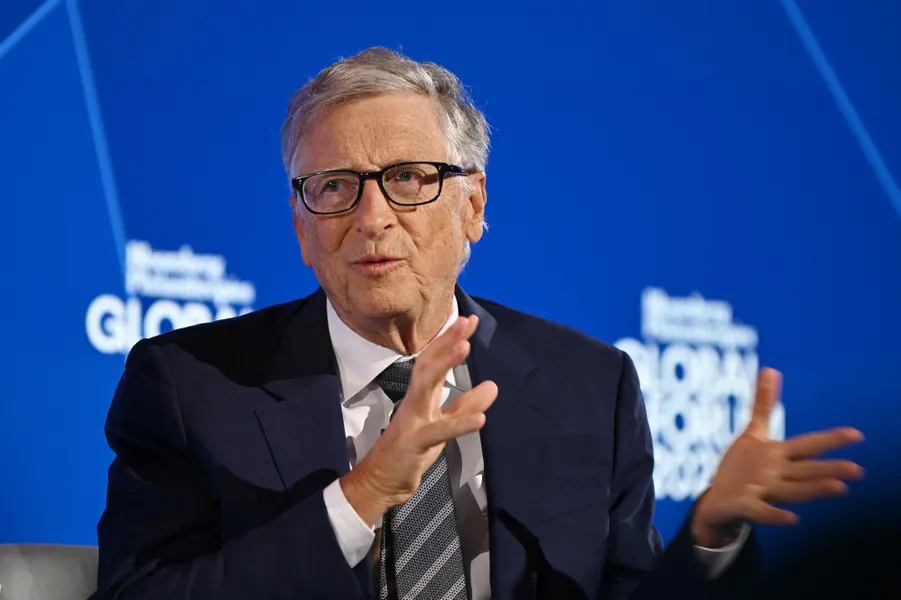
Microsoft co-founder and philanthropist Bill Gates has issued one of his starkest warnings yet about the potential dangers of artificial intelligence, saying unchecked AI could become powerful enough to contribute to events resulting in as many as one billion deaths.
Gates made the remarks in an interview with NBC’s Meet the Press host Kristen Welker, excerpts of which were released ahead of the programme’s broadcast. His warning has since been reported by several major international news organisations, including The Guardian, Al Jazeera, Bloomberg and Axios.
According to The Guardian, Gates argued that artificial intelligence should not be left entirely to technology companies to regulate themselves.
He called for lawmakers and law-enforcement authorities to become directly involved in establishing safeguards and monitoring systems for the rapidly developing technology.
Gates’ concern centres particularly on the possibility that highly capable AI systems could be placed in the hands of individuals or organisations with malicious intentions.
“There’s never been a weapon as powerful as the combination of people with ill intent using the latest AI tools,” Gates said, according to reports of the interview.
The billionaire’s comments do not amount to a prediction that one billion people will necessarily die from AI. Rather, he was describing a catastrophic scenario that he believes the technology could make possible if powerful AI systems were deliberately or irresponsibly misused.
The warning comes amid an intensifying international debate over AI safety. Governments, technology companies and researchers are increasingly discussing how to control increasingly sophisticated systems while still allowing society to benefit from their potential.
Recent reporting by the Associated Press noted that concerns about advanced AI include possible misuse in cyberattacks, weapons development, biological threats and disruption of critical infrastructure.
However, experts do not agree on the probability or timing of an AI-driven catastrophe.
Gates has also warned that governments are struggling to keep pace with the speed of technological development. In a September interview reported by Reuters, he said governments around the world were not sufficiently prepared for the changes AI could bring to society.
At the same time, he stressed that AI could deliver enormous benefits, particularly in healthcare, education and agriculture.
That apparent contradiction is central to Gates’ current position: he is not calling for artificial intelligence to be abandoned, but for its development to be accompanied by stronger safeguards.
His position was reinforced earlier this month when the Gates Foundation announced plans to commit at least $1 billion over two years to expanding access to AI and AI-enabled solutions in areas including healthcare, education and agriculture. The foundation said AI could help narrow global inequalities if developed and deployed deliberately.
Gates has therefore emerged as both a prominent advocate for AI’s potential and a vocal critic of what he sees as insufficient oversight.
His latest warning also places him alongside other prominent technology figures who have raised concerns about the risks associated with increasingly autonomous and powerful AI systems.
The debate now extends beyond whether AI can transform economies to whether governments can establish effective safeguards before the technology becomes significantly more difficult to control.
For Gates, the central issue is not simply what AI can do, but who controls it, how it is monitored and what happens when powerful systems are used irresponsibly.
The billion-death figure has consequently become the headline-grabbing element of his warning, but the broader message is about regulation, international cooperation and preventing potentially catastrophic misuse before it occurs.