The United States is deepening its footprint in one of the world’s most strategic mineral hubs after securing access to the Democratic Republic of Congo’s vast tantalum reserves, in a move that blends economic ambition with diplomatic efforts to stabilize the conflict-hit nation.
At the heart of the agreement is the Manono region in southeastern Democratic Republic of the Congo, home to one of the largest known tantalum deposits globally.
The deal also covers the Rubaya mining area in North Kivu, a key source of coltan the ore from which tantalum is extracted.
Tantalum is a critical input in smartphones, semiconductors, electric vehicles, and military electronics, making it a highly strategic resource in the global race for advanced technologies.
According to Reuters, Congolese and U.S. officials confirmed that Rubaya was included on a shortlist discussed during a February 5 meeting in Washington aimed at advancing a strategic minerals partnership first agreed in December.
Reducing Western Dependence on China
The agreement forms part of a broader U.S. push to reduce Western reliance on China, currently the dominant processor of critical minerals.
Washington’s strategy includes backing mining investments and strengthening supply chains tied to Congo’s vast reserves of cobalt, lithium, copper, and tantalum minerals essential to the global energy transition.
Rubaya alone accounts for roughly 15 percent of global coltan output, with tantalum concentrations ranging between 20 and 40 percent. However, much of the mining is done manually by impoverished locals earning only a few dollars per day.
Mineral Diplomacy and Regional Peace Efforts
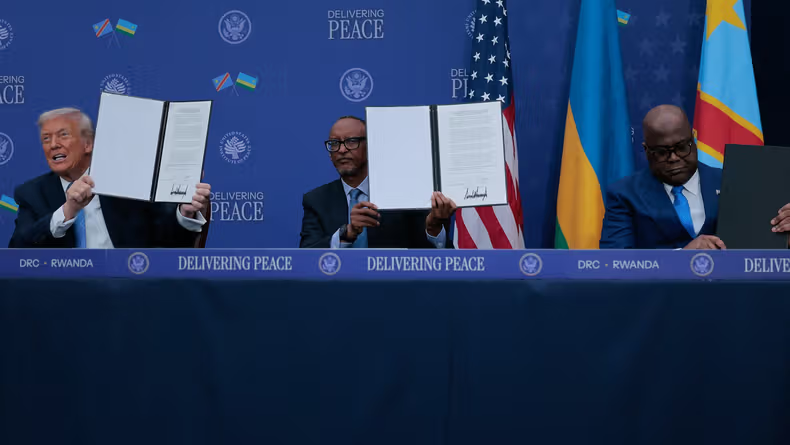
Beyond commercial interests, Washington is tying mineral access to diplomatic efforts aimed at easing tensions between Democratic Republic of the Congo and neighboring Rwanda, whose long-standing rivalry has fueled violence in eastern Congo for decades.
U.S. officials have encouraged both nations to pursue peace talks alongside economic agreements that could unlock billions of dollars in mining investment. American policymakers increasingly view formal mineral development as a stabilizing force capable of undermining illegal trafficking networks that finance armed groups.
The Rubaya mine and surrounding hills remain under the control of AFC/M23 rebels, whose activities have fueled organized smuggling operations into Rwanda, according to a United Nations report last year.
The U.N. estimates the group collects at least $800,000 monthly from taxes on coltan production and trade an allegation Rwanda denies backing.
A Geopolitical and Technological Pivot
For the United States, securing access to Congo’s mineral wealth strengthens supply chains vital to defense, electronics, and clean energy industries while countering China’s growing influence in Africa’s mining sector.
For Congo, the partnership offers a pathway to attract foreign investment, modernize mining infrastructure, and reduce conflict linked to informal mineral extraction.
As global demand for critical minerals accelerates, the U.S.–Congo partnership could reshape both the trajectory of the tech industry and the geopolitical balance in Africa’s resource-rich heartland.