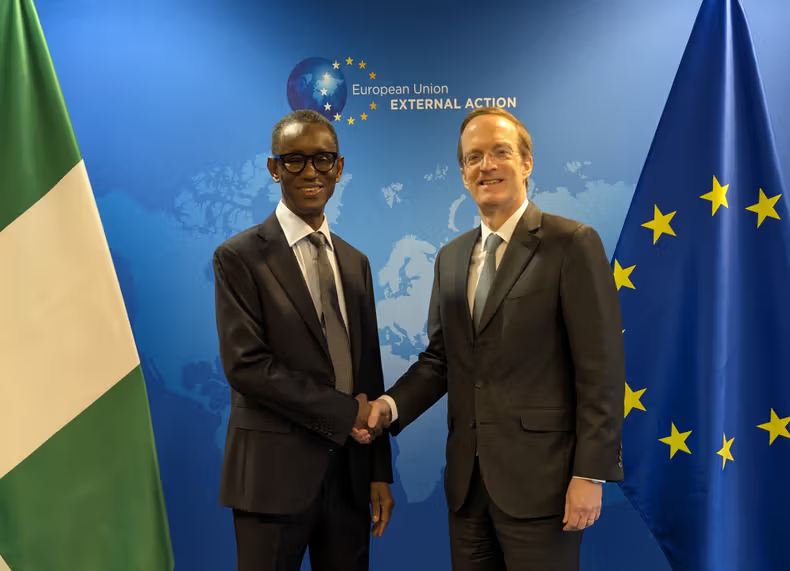
The European Union has launched its first-ever defense dialogue with Nigeria, reinforcing bilateral security cooperation and disclosing that it has committed €234.4 million so far to support Nigeria’s security task force.
The inaugural Peace, Security and Defence Dialogue was held on February 18, 2026, in Brussels.
The meeting was co-chaired by Charles Fries, Deputy Secretary-General of the European External Action Service, and Nigeria’s National Security Adviser, Nuhu Ribadu.
Discussions covered counter-terrorism, maritime security, cyber threats, transnational organized crime, disarmament, demobilization and reintegration (DDR), and peace mediation, with both sides exploring avenues for stronger operational collaboration.
For more than a decade, the EU and Nigeria have partnered on regional security efforts across the Lake Chad Basin and the Gulf of Guinea, blending humanitarian, development and security interventions.
These initiatives include DDR programmes, justice sector reform, mediation efforts and community resilience projects.
Between 2015 and 2025, the EU channeled over €700 million to Nigeria, including €500 million in humanitarian assistance, positioning Nigeria as the bloc’s largest bilateral development partner in Sub-Saharan Africa. Of that total, €234.4 million has been directed specifically to strengthening Nigeria’s security task force, enhancing coordination, operational responsiveness and institutional capacity.
The renewed engagement comes as Nigeria grapples with layered security challenges: jihadist insurgency in the northeast, banditry and mass kidnappings in the northwest, oil theft in the Niger Delta, and maritime crime in the Gulf of Guinea. Despite record defense spending in recent years, persistent violence continues to weigh on public finances and dampen investor confidence.
The EU’s move also reflects Nigeria’s expanding web of defense partnerships. The United States has long supported Abuja through training, intelligence-sharing and arms sales, while Turkey has strengthened defense exports including drones and tactical systems as it expands its footprint across Africa.
Analysts describe Nigeria’s growing multi-partner security strategy as both pragmatic and strategic. With its armed forces stretched across multiple conflict zones, Abuja requires advanced surveillance systems, intelligence capabilities and cybersecurity tools that external partnerships can help deliver.
However, observers caution that foreign assistance alone cannot resolve the country’s deep-rooted insecurity. Structural issues such as weak local governance, porous borders, and youth unemployment and arms proliferation demand sustained domestic reforms. Excessive reliance on foreign partners could also create long-term strategic dependencies.
Nonetheless, as the region’s largest economy and most populous nation accounting for nearly half of West Africa’s population and about 60 percent of its GDP Nigeria’s stability remains critical to regional security.
With insecurity persisting, Abuja appears committed to leveraging global partnerships from Washington to Ankara and Brussels to restore stability and safeguard economic growth.