The 2026 World Economic Forum (WEF) has officially commenced in Davos, Switzerland, once again bringing together global political leaders, business executives, policymakers and innovators to deliberate on some of the world’s most pressing challenges from geopolitics and climate change to economic growth, technology and global security.
Held annually in the Swiss alpine resort, the forum has become a critical platform for shaping international dialogue and cooperation.
This year’s meeting, themed “A Spirit of Dialogue,” comes at a particularly turbulent moment for the global order.
Trump Dominates the Spotlight
As expected, United States President Donald J. Trump has emerged as the dominant figure at Davos 2026, with his recent foreign policy moves and uncompromising rhetoric unsettling allies and rivals alike.
Trump’s attendance has drawn heightened attention amid growing tensions between Washington and several European capitals, particularly over his controversial demand that Denmark relinquish control of Greenland to the United States.
At the forum, Trump is holding a series of high-level meetings with European leaders alarmed by his insistence that Denmark cede the Arctic territory a proposal he has framed as vital to U.S. national security and a means of countering Chinese and Russian influence in the region.
French President Emmanuel Macron, in a private message later posted by Trump online, expressed disbelief over the proposal, writing: “I do not understand what you are doing on Greenland.”
Trump has threatened to impose 10 percent tariffs on Denmark and seven other European nations if they fail to reach an agreement on Greenland. He has also refused to rule out military action, a stance that has sent shockwaves through diplomatic circles.
When asked how far he was prepared to go to bring Greenland under U.S. control, Trump responded bluntly at a White House press conference: “You’ll find out.”
A Shifting Global Order
The Davos meeting is taking place against the backdrop of what many analysts describe as a fundamental challenge to the post World War II international system.
In recent weeks, President Trump has moved to upend established trade rules, withdraw from multilateral institutions including the UN climate treaty and escalate confrontations across multiple regions. His administration has also intensified pressure on Venezuela, following the capture of President Nicolás Maduro after unrest in Caracas, and has threatened further geopolitical realignments.
Just days before the forum opened, Trump warned that tariffs would be imposed on eight NATO allies, including Germany, France and the United Kingdom, unless they support U.S. control of Greenland a move that prompted sharp rebukes from European leaders.
The impact of these policies on global peace, politics and the economy is expected to dominate discussions throughout the five-day event, which runs from January 19 to 23, 2026.
WEF President and CEO Børge Brende underscored the urgency of dialogue in his opening remarks.
“Dialogue is not a luxury in times of uncertainty; it is an urgent necessity,” Brende said.
“At a critical juncture for international cooperation marked by profound geoeconomic and technological transformation, this year’s annual meeting will be one of our most consequential.”
Global Leaders Converge
President Trump is joined in Davos by more than 60 heads of state and government, including German Chancellor Friedrich Merz, Canadian Prime Minister Mark Carney, Argentine President Javier Milei, European Commission President Ursula von der Leyen, China’s Vice Premier He Lifeng, Pakistani Prime Minister Shehbaz Sharif, and Syrian leader Ahmad al-Sharaa.
Trump is leading the largest U.S. delegation ever to attend Davos, comprising five cabinet secretaries and senior officials, including Secretary of State Marco Rubio, special envoy Steve Witkoff, and senior adviser Jared Kushner.
He is also expected to meet Ukrainian President Volodymyr Zelenskyy and leaders of Kyiv’s G7 allies to discuss security guarantees for Ukraine following any potential peace agreement with Russia.
European leaders, meanwhile, are using their engagements to press Trump to reconsider his tariff threats and retreat from his Greenland proposal.
Economic Pressures and Global Risks
Beyond geopolitics, the forum is focusing on mounting economic pressures. While the global economy has shown resilience amid trade tensions buoyed partly by massive investments in artificial intelligence in the United States projected global growth of 3.1 percent in 2026 remains below optimal levels.
Global debt has reached its highest point since World War II, with several African countries facing particularly severe debt vulnerabilities, according to the International Monetary Fund.
Protectionist trade policies, unilateral tariffs, restrictions on foreign investment and tightening control over critical minerals have intensified what the WEF’s Global Risks Report describes as growing “geo-economic warfare.”
Artificial Intelligence in Focus
Artificial intelligence is once again a central theme at Davos, with top technology leaders including Microsoft CEO Satya Nadella, Nvidia CEO Jensen Huang, and Google AI chief Demis Hassabis in attendance.
While AI is delivering breakthroughs in medicine, education and productivity, concerns remain about its impact on employment. Anthropic CEO Dario Amodei warned that AI could eliminate up to half of entry-level white-collar jobs within the next five years, underscoring the urgent need for reskilling and workforce adaptation.
New Era at the World Economic Forum
This year’s meeting is the first since the departure of WEF founder Klaus Schwab, who stepped down in April 2025. Schwab was succeeded by interim co-chairs Larry Fink, CEO of BlackRock, and Andre Hoffmann, vice chairman of Roche Holdings.
Despite internal challenges and growing skepticism toward multilateralism, the strong turnout of global leaders signals the forum’s continued relevance.
Nigeria Makes Strong Presence
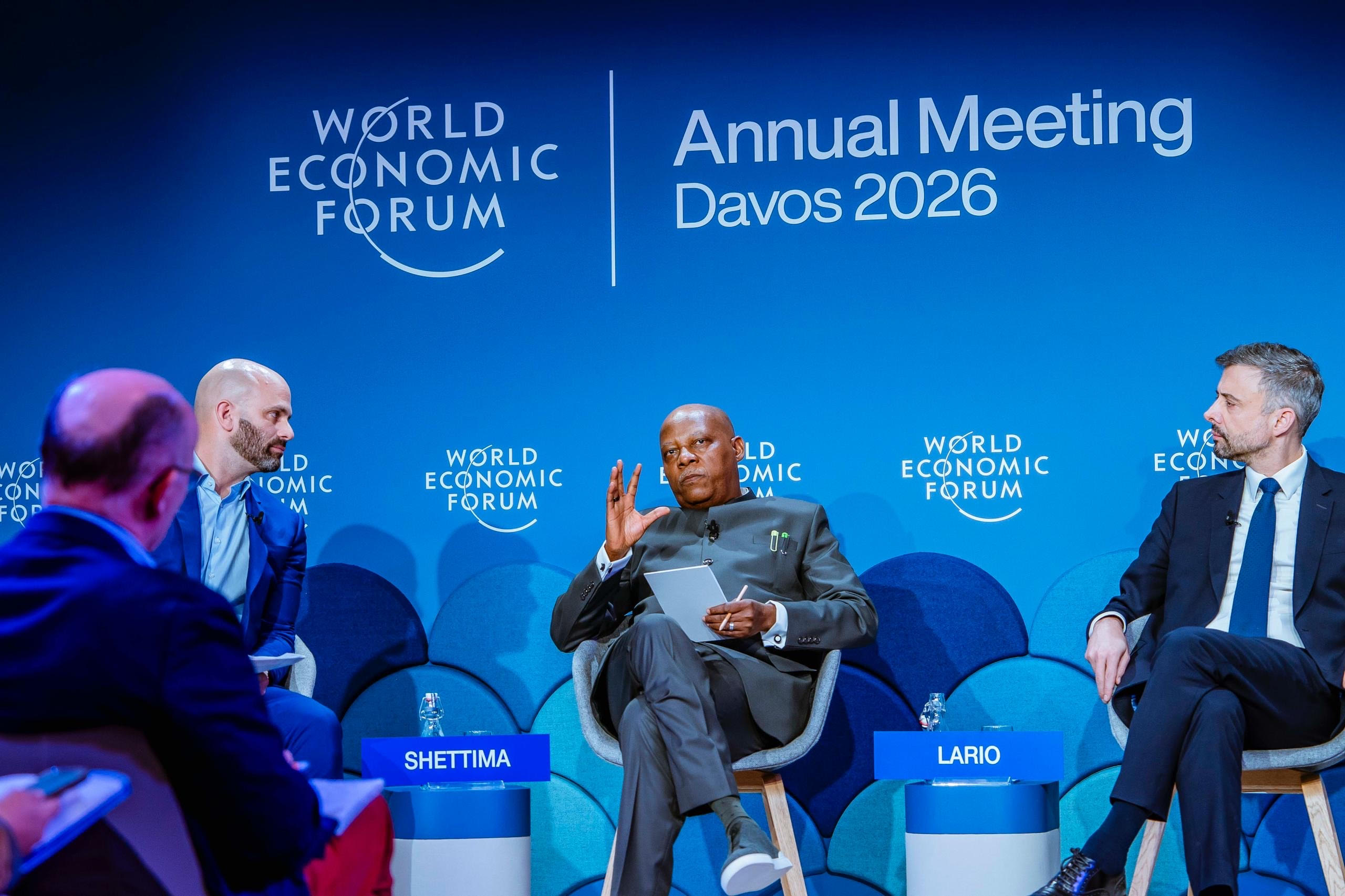
Nigeria is also making a significant mark at WEF 2026. Vice President Senator Kashim Shettima, GCON, is leading a high-level delegation that includes the Minister of Innovation, Science and Technology, Dr. Kingsley Udeh, SAN, and the Minister of Industry, Trade and Investment, Dr. Jumoke Oduwole, among others.
On Monday, January 19, Vice President Shettima formally inaugurated Nigeria House in Davos, describing it as a symbol of the country’s renewed commitment to global economic engagement, investment promotion and strategic partnerships.
He said the initiative reflects Nigeria’s determination to reposition itself as a serious contributor to global economic discourse and emphasized that long-term success would be driven by strong private-sector participation.
Dr. Udeh noted that Nigeria is deliberately positioning science, technology and innovation as a cornerstone of economic diversification and inclusive growth, in line with President Bola Ahmed Tinubu’s Renewed Hope Agenda.
Nigeria House is expected to serve as a hub for investment discussions, innovation partnerships and high-level engagements throughout the forum.
A Tense Yet Pivotal Gathering
As leaders debate the future of trade, security, technology and cooperation, Davos 2026 is shaping up to be one of the most consequential editions in recent memory marked by geopolitical tension, economic uncertainty and an urgent search for dialogue in a fractured world.